


You're dressed for leggings, but dinner is on the calendar too. The thong looks invisible under your outfit, while the cheeky feels kinder for a long day. Suddenly, choosing underwear isn't a minor detail. It's wardrobe strategy.
The honest answer to thongs vs cheekies depends on movement, fabric, rise, and what you're wearing. A thong can be the most stable option under close-fitting clothes, while a cheeky can feel better during long sitting or high-sweat days. Neither cut wins every situation, and the smartest drawer usually includes both.
Table of Contents
- Why This Comparison Deserves a Real Answer
- What Each Cut Actually Looks and Feels Like
- Fit and Coverage Side by Side
- Comfort, Friction, and What the Evidence Says
- Matching the Cut to the Outfit and the Day
- A Simple Framework for Choosing Your Next Pair
- How Nuage Wears Styles Map to Real Scenarios
- Questions Worth Answering Before You Choose
Why This Comparison Deserves a Real Answer
The usual underwear debate treats coverage as the only decision. More coverage supposedly means more comfort, and less coverage supposedly means fewer visible lines. That shortcut misses what happens when you walk, sit, sweat, stretch, commute, and change outfits during the same day.
I've worn both cuts through desk days, workouts, flights, and evenings in fitted clothes. The difference isn't abstract. A loose cheeky can bunch at the back when you walk, while a well-sized thong can stay completely still. On another day, the thong's narrow contact path can feel irritating after hours in damp workout clothes, while the cheeky spreads pressure more gently.
The useful comparison looks at rear coverage, front coverage, gusset width, rise, edge construction, fabric, friction, and movement. Those details explain why the same cut can feel excellent in one outfit and completely wrong in another.
The thong has a long history in body-conscious fashion. Its modern development came from performance culture, public regulation, and swimwear innovation, including Rudi Gernreich's thong swimsuit in 1974. The Victoria and Albert Museum records that the design was produced as women's underwear by Lily of France from 1975, helping move it from beachwear into everyday intimates. Commercial adoption later expanded through the 1980s and 1990s, and a widely cited estimate placed thongs at approximately 31% of the women's underwear market by the early 2000s. Read the historical overview of the thong's development.
You don't need to switch permanently from one cut to the other. Build a small, intentional rotation with two or three reliable options, then choose according to the outfit and the demands of the day.
What Each Cut Actually Looks and Feels Like
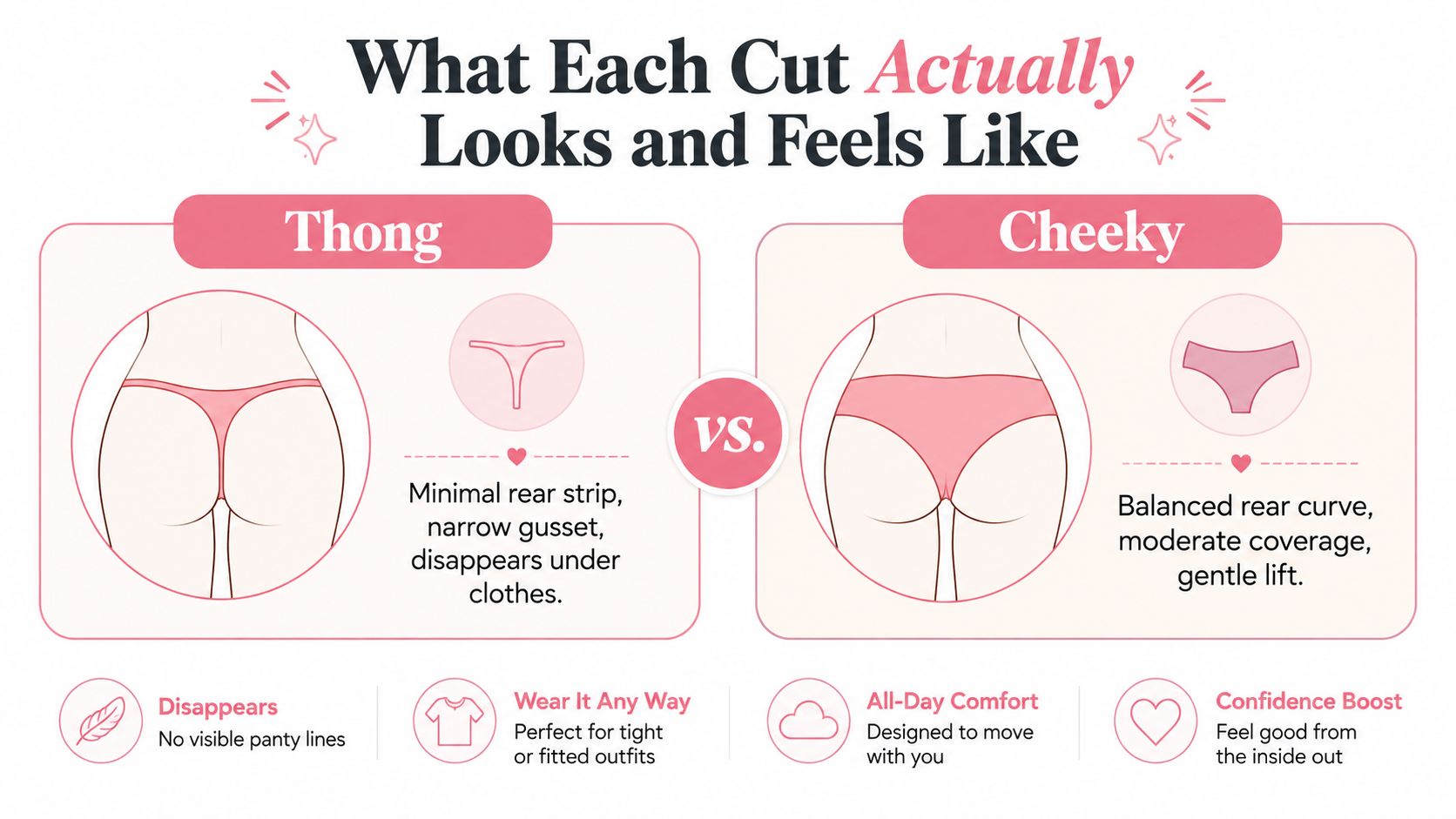
A thong has a fuller front panel and a narrow rear strip that sits between the buttocks. The strip connects to the waistband with very little fabric across the rear, which is why the style can disappear beneath leggings, silk, fitted trousers, and close-cut dresses.
A cheeky sits between a thong and a fuller bikini or brief. Its rear panel covers the lower part of the buttocks while exposing more of the upper curve. The shape often creates a lifted, curved outline without the full rear coverage of a traditional brief.
Start with the rear panel
Look at the back of the garment laid flat. A thong will show a slim strip or narrow central panel. A cheeky will show a wider curved panel that reaches farther across each cheek. That distinction affects both line visibility and pressure distribution.
The front matters too. A thong can still have a full front panel, but the gusset may be narrow. A cheeky commonly retains a broader front and gusset, giving you more fabric between your body and your clothing.
Check the rise
Both cuts can be low-rise, mid-rise, or high-rise. Rise describes where the waistband sits, and it can change the experience more than the rear panel does.
- Low-rise sits around the hips and works best with low-rise trousers or skirts.
- Mid-rise sits closer to the natural waist and suits everyday trousers and skirts.
- High-rise reaches higher on the torso, often near or above the navel, and pairs with high-waisted clothing.
A low-rise thong under high-rise trousers can feel misplaced even when the rear fit is perfect. A high-rise cheeky under low-rise jeans can create unnecessary bulk or peek above the waistband.
Bikinis and briefs sit farther toward the fuller-coverage side of the spectrum. A bikini usually offers moderate rear coverage, while a brief covers more of the hips, buttocks, and lower stomach. Cheekies occupy the middle, and thongs sit near the minimal-coverage end.
The label only gives you a starting point. Fabric stretch, seam placement, elastic recovery, edge finish, and gusset construction determine whether a cut stays comfortable.
Fit and Coverage Side by Side
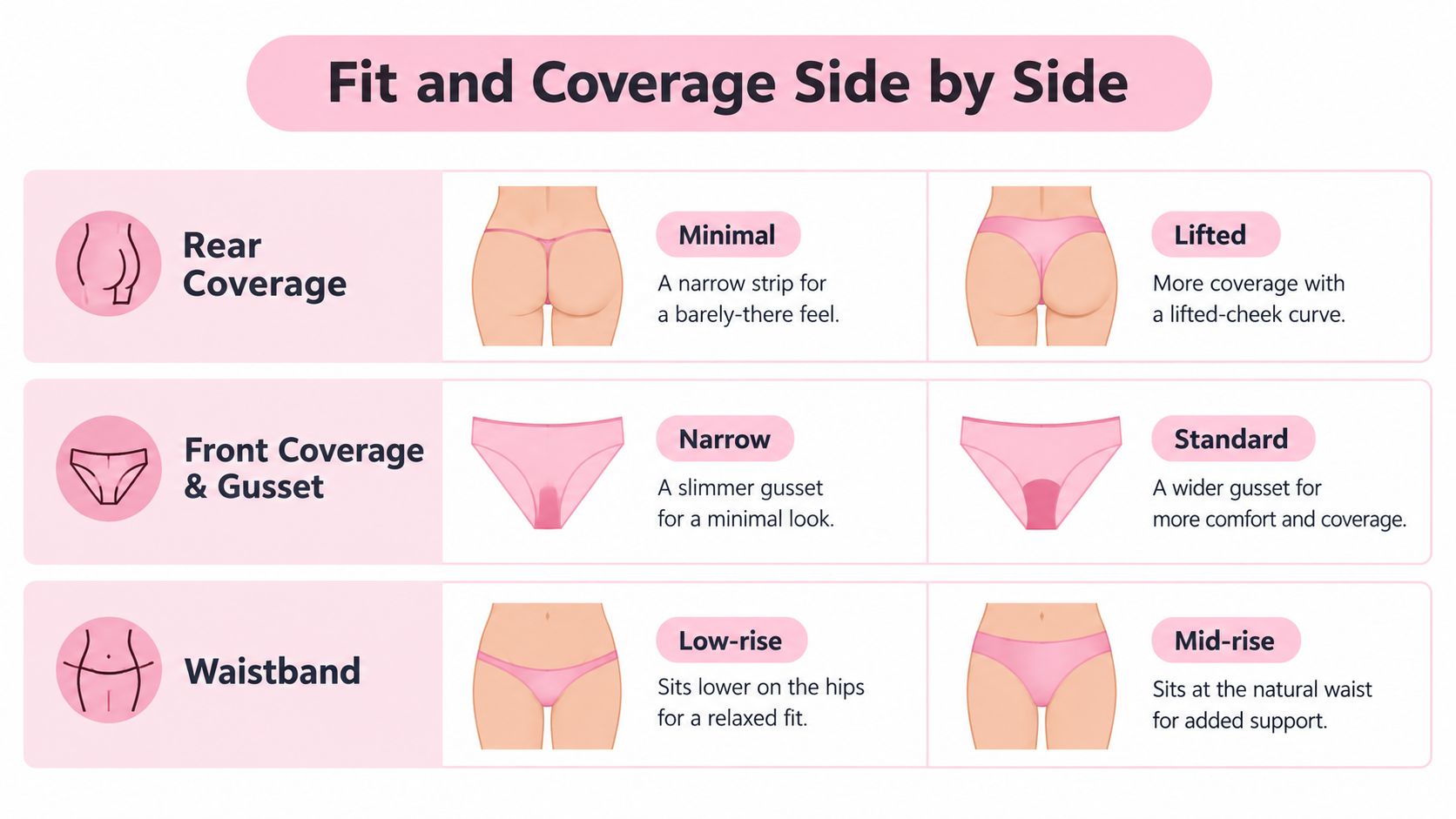
A thong's main advantage is minimal rear coverage. With less fabric touching the buttocks, there's less material available to imprint beneath thin, close-fitting clothing. That makes it the sharper tool for leggings, silk, formalwear, and body-skimming outfits.
A cheeky gives you more rear coverage and spreads pressure across a broader surface. It can feel softer during desk work, travel, and casual clothing, but its wider edge creates more opportunity for bunching or visible lines if the garment is loose or the fabric is thin.
The waistband deserves equal attention. A low-rise cut can sit below the natural waist, while a mid-rise or high-rise version may feel more secure with trousers that sit higher on the body. The leg opening also changes the experience. A high-leg cut exposes more of the hip and can reduce fabric near the upper thigh, while a lower opening may feel more contained.
| Criterion | Thong | Cheeky |
|---|---|---|
| Rear coverage | Minimal rear strip | Curved panel covering part of the buttocks |
| Front coverage and gusset | Often full front with a narrower gusset | Usually fuller front with broader coverage |
| Waistband | Available in low, mid, and high rises | Available in low, mid, and high rises |
| Visible lines | Strong choice when reduced rear fabric matters | Can stay discreet with smooth, low-profile edges |
| Pressure | Concentrated along a narrow path | Distributed across a wider panel |
| Movement | Can stay stable when correctly sized | Can reduce concentrated rubbing but may bunch if loose |
| Best use | Leggings, silk, fitted trousers, formalwear | Desk days, travel, casual clothing, softer coverage |
If high waistlines are a regular part of your wardrobe, compare construction as carefully as coverage. A high-waisted cheeky style can make more sense than a low-rise cut that fights with the waistband of your trousers.
The real difference isn't how much fabric each cut shows. It's how that fabric sits under the clothes you actually wear.
Comfort, Friction, and What the Evidence Says
The idea that thongs automatically cause infections doesn't hold up. A cross-sectional survey of 986 women found no significant difference in reported urinary tract infection, yeast vaginitis, or bacterial vaginosis outcomes between thong wearers and non-thong wearers, and thong use wasn't an independent predictor after adjustment. Review the published survey findings.
That doesn't mean every thong feels good for every body. It means the cut alone shouldn't carry the blame. Fit, moisture, friction, fabric composition, and gusset construction are more useful variables when you're trying to understand discomfort.
Why moisture changes the experience
Textile testing found that skin-to-fabric friction generally rises as knitted fabric moisture increases. Tighter structures and higher elastane configurations also produced the highest measured friction in the tested materials. Read the textile friction research.
In plain language, damp fabric can drag more against the skin. A thong concentrates contact along a narrow perineal and gluteal path, so a sizing mistake or rough edge can feel intense in one small area. A cheeky spreads pressure across more skin, which may reduce the single-line rubbing sensation, though a loose panel can bunch and create its own irritation.
The best comfort test compares the same fabric and gusset construction in both cuts. Notice whether the waistband digs, whether the leg edge rolls, whether the rear panel migrates, and whether the fabric stays damp during movement.
Breathability matters, especially for workouts and hot commutes. A cotton or moisture-managing gusset is a more defensible comfort feature than claiming one silhouette is healthier by nature.
Recurring pain, burning, or irritation isn't the price of avoiding visible lines. Treat it as a fit or medical concern and raise it with a clinician.
Matching the Cut to the Outfit and the Day
Choose the outfit first, then choose the cut. That order prevents most underwear mistakes.
For leggings and workout sets, start with a properly sized thong made with smooth, low-profile or laser-cut edges. It removes the broad rear edge that can show through stretch fabric. The thong still needs enough front coverage and a stable gusset. If it shifts or feels damp, a breathable cheeky remains a valid choice. Use the guide to avoiding visible panty lines when you're checking edge construction and outfit compatibility.
For silk slips and bias-cut skirts, a thong usually protects the drape more effectively because the reduced rear panel creates less fabric-to-garment contact. A cheeky can work when it has a genuinely smooth edge, but test it under the exact fabric rather than assuming the label means invisible.
High-rise trousers need a different approach. A mid-rise cheeky can meet the waistband cleanly, provide a little more coverage, and avoid the awkward gap created by a low-rise thong. If your trousers are thin, look for flat construction and a front panel that doesn't create an outline.
Long flights and desk days reward pressure distribution. A soft cheeky with a stable waistband can feel easier over extended sitting, particularly if a narrow thong path starts to irritate. The best version won't roll at the waist or bunch at the leg opening.
Sweat changes the recommendation. A cheeky may outperform a thong on a humid commute because it spreads contact and can feel less sharply abrasive when damp. During a workout, a thong may stay more stable than a loose cheeky, especially under fitted shorts.
Choose by what shows on the body and what the body is doing, not by the cut's reputation.
A properly sized thong can cause less bunching than a loose cheeky. An incorrectly sized thong can concentrate friction and create a wedged sensation. Your calendar should decide the rotation: thong for fitted clothing and stable minimal edges, cheeky for coverage, pressure distribution, and softer long-wear situations.
A Simple Framework for Choosing Your Next Pair
Before buying, run through five questions.
- What's the outfit? Thin, close-fitting fabric favors a thong or a cheeky with low-profile edges. Relaxed trousers give you more freedom.
- What's the activity? Sitting, walking, commuting, training, and traveling place different demands on the garment.
- What rise matches the clothing? Match low-rise underwear with low-rise bottoms, mid-rise with everyday trousers, and high-rise with higher waistbands.
- What fabric will touch the skin? Look for a soft, breathable or moisture-managing gusset, especially for long or active days.
- What failed before? If a pair rolled, rubbed, pinched, migrated, or stayed damp, identify the construction problem instead of just changing the silhouette.
Fit beats cut. A thong that's too small can feel worse than a correctly fitted cheeky, while a cheeky with poor stretch recovery can bunch more than a stable thong. The rear panel gets attention, but the gusset, waistband, leg opening, and fabric determine whether the garment earns repeat wear.
Treat thongs vs cheekies as a wardrobe design problem. Assign each cut a job instead of forcing one pair to handle every outfit and activity.
Switching between cuts through the week is practical and body-friendly. It gives you a solution for invisible lines without asking your skin to tolerate rubbing or dampness all day.
How Nuage Wears Styles Map to Real Scenarios
Nuage Wears organizes its underwear around problems such as visible lines, wedging, digging, overheating, and rolling. That makes the range easier to assess by situation rather than by silhouette alone.
For everyday no-show wear under leggings and workwear, the NuCloud thong and brethet are positioned for smooth, low-visibility use. The NuAir thong suits days when airflow and moisture management matter, including active routines and warm commutes. The NuShield thong is the more targeted option when a smoothing front panel matters beneath thin fabrics.
For desk-to-dinner plans, long-haul travel, and softer off-duty hours, look toward a cheeky or mid-rise brief from the NuCloud and NuFit families. Their broader coverage can distribute pressure more evenly, while bonded bands are designed to resist rolling and help the garment stay placed during movement.
The No Show Secret Thong Mystery Box and Curve Comfort Mystery Box work as bundling options for stocking up on thong styles at value pricing. They make sense when you already know that minimal rear coverage fits your regular outfits and you want a more varied rotation.
A useful Nuage drawer isn't one hero product. Two or three styles can cover invisible workwear, active days, travel, and relaxed coverage.
Questions Worth Answering Before You Choose
Do thongs cause infections? The available survey evidence doesn't show thong use alone as an independent predictor of the reported urinary, yeast, or bacterial outcomes discussed earlier. Focus on breathable fabric, a suitable gusset, correct sizing, and changing out of damp underwear.
How do I stop a cheeky from riding up? Check the rise, leg-opening tension, and edge finish. A bonded or low-profile edge can help the garment stay flat, but no construction can rescue a size or shape that doesn't match your body.
Are thongs suitable for workouts? Yes, when the thong fits correctly and uses smooth, breathable construction. A breathable cheeky is also a sensible choice for high-sweat sessions if it stays flat and doesn't bunch.
When should I switch cuts? Switch when rubbing, rolling, migration, or persistent dampness keeps appearing. Don't wait for a particular day of the week or force yourself to finish a workout in a pair that's clearly working against you.
The best answer to thongs vs cheekies is a wardrobe skill. Learn which cut stays invisible, which one distributes pressure, and which fabric behaves well in your actual routine.
Nuage Wears offers thong and fuller-coverage options for no-show workwear, breathable movement, travel, and softer everyday wear. Explore the Nuage Wears range to build a practical drawer that matches your outfits instead of forcing one cut to do every job.


