


You leave your desk, swap your laptop bag for a gym bag, and hope the bra under your shirt can handle the change of pace. It needs to look polished beneath a loose button-down, stay steady during a run, and feel dry enough for the trip home. A navy sports bra can fit beautifully into that routine, but the color is only the beginning. Support comes from construction, fit, fabric, and care.
Table of Contents
- Why a Navy Sports Bra Earns a Spot in Your Drawer
- How Support Really Works Beyond Low Medium and High
- How to Choose Fabric Straps and Size That Stay Put
- Navy Sports Bra Outfit Ideas for Workout to Weekend
- How to Keep Your Navy Sports Bra Fresh and Chafe Free
- Find Your Stay Put Navy Match and Move With Ease
Why a Navy Sports Bra Earns a Spot in Your Drawer
Navy has an easy versatility. It looks crisp with black leggings, softens bright workout layers, and slips naturally beneath denim, white shirts, or relaxed tailoring. It can also conceal visible sweat marks better than pale colors, which makes it practical for a day that moves from commute to training to errands. That visual advantage doesn't mean the fabric is drier or that the bra offers more support.
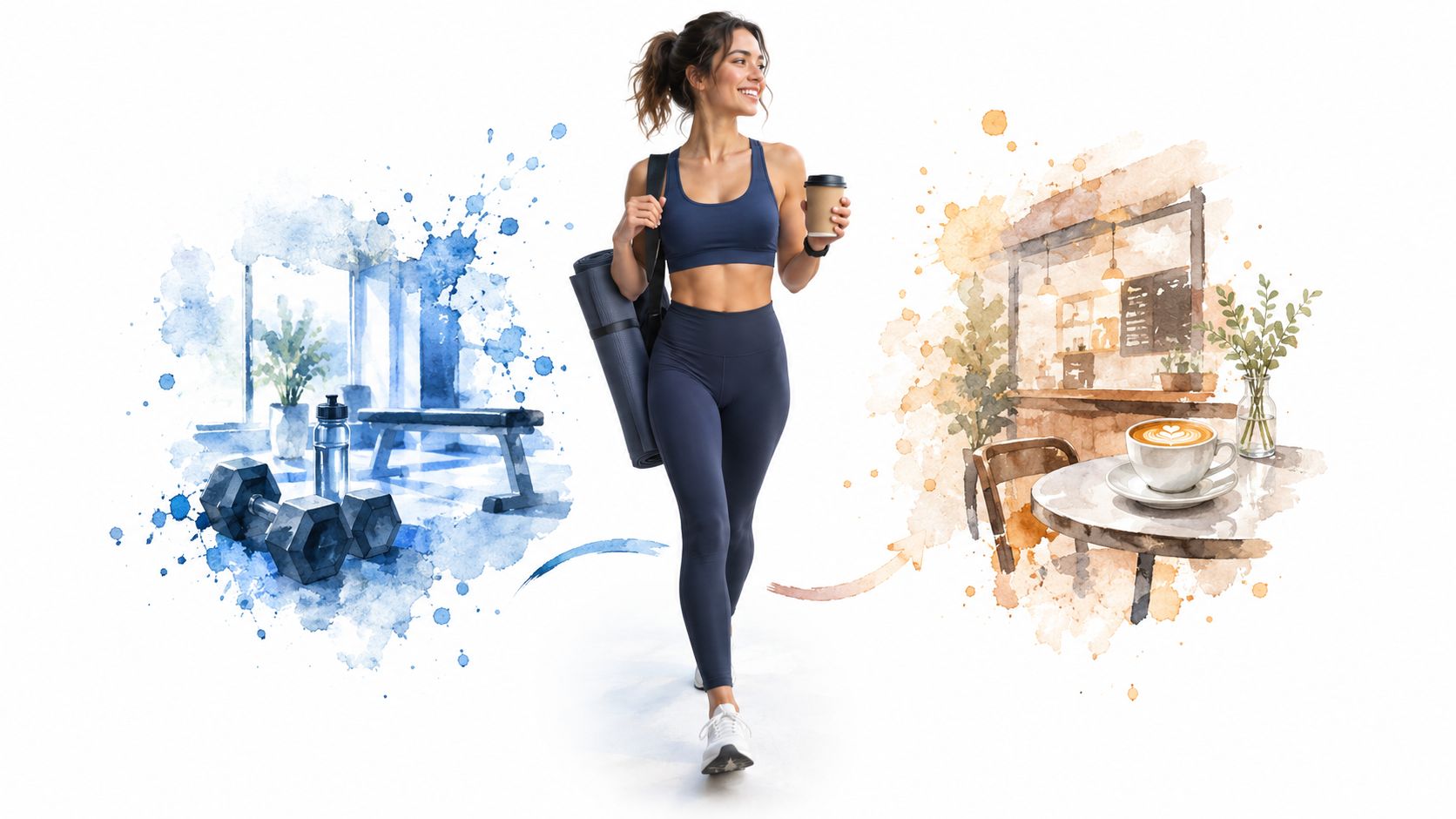
A navy sports bra should be judged by its support architecture, not by its shade, neckline, or a label such as “high support.” Compression and encapsulation designs can feel and behave differently across breast sizes, activities, and comfort needs, as discussed in this systematic review of sports-bra research. The right choice controls movement without turning every breath into a negotiation.
The four questions that simplify shopping
- What movement will it handle? Running and jumping need dependable containment. Strength training may need freedom for pressing, pulling, and rotation. Low-impact sessions may favor softness and mobility.
- Where should support come from? Look at the underband, cups, straps, neckline, and fabric together rather than treating one feature as magic.
- How should it feel? Snug is useful. Pinching, restricted breathing, sliding, and concentrated pressure are warning signs.
- How will you wear it afterward? If the bra stays damp through a commute or travel day, drying behavior matters as much as first-wear comfort.
Think of navy as a styling decision, then make support and comfort the performance decisions. That small change keeps a darker color from disguising a poor fit.
How Support Really Works Beyond Low Medium and High
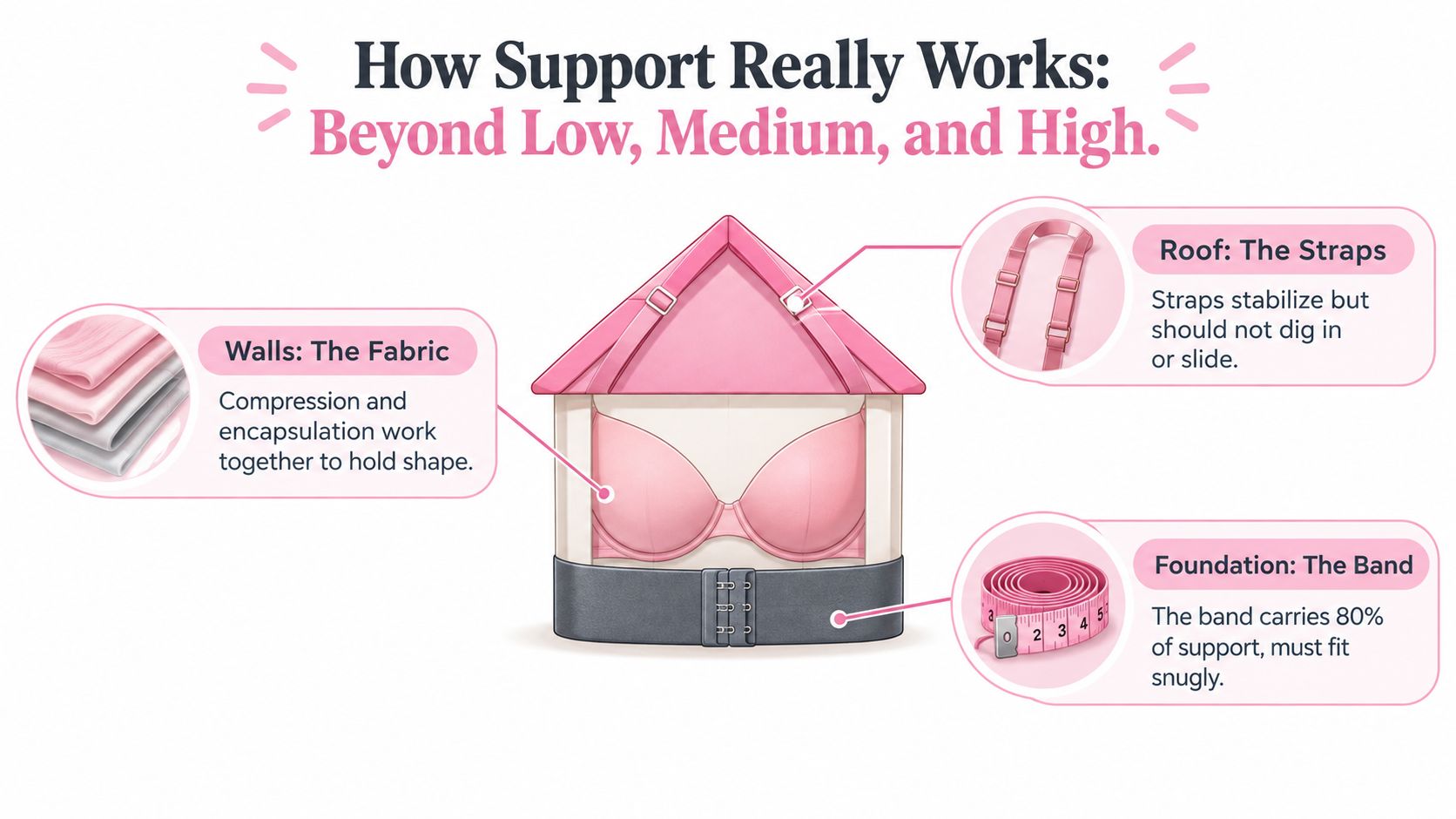
A support label is a shortcut, not a measurement. A better mental model is a house. The underband is the foundation, the cups and fabric are the walls, and the straps act like the roof structure that keeps everything aligned. If one part fails, tightening another part won't automatically solve the problem.
Start with motion, not marketing language
Sports-bra support is best evaluated through measured three-dimensional breast-motion reduction, rather than labels such as low, medium, or high. In a study of 98 sports bras, design variables including encapsulation construction, padded cups, nylon content, an adjustable underband, and a higher neckline collectively explained 37.1% of the variation in breast-motion reduction. The findings are reported in this study of sports-bra characteristics and performance.
That result is useful because it shows why no single feature guarantees success. The band can limit upward movement, shaped or separate cups can manage independent breast movement, and neckline coverage can help control motion near the upper torso. You still need a fit that works for your body and movement pattern.
Compression presses the breasts closer to the torso, creating a unified shape. Encapsulation uses separate cups or shaped zones to contain each breast more independently. A combination design uses both ideas. None is automatically superior for every wearer. Breast size, torso length, sensitivity to pressure, and the direction of movement all matter.
| Activity and needs | Prioritize this architecture | Fit cue to check |
|---|---|---|
| Running and repeated jumping | Encapsulation or combination support, stable band, controlled neckline | Bounce stays contained, and the band doesn't ride upward |
| Strength training with pressing and pulling | Supportive cups with flexible fabric and straps | You can reach overhead and rotate without twisting |
| Directional training and court-style movement | Firm band plus secure cups and neckline coverage | The bra stays centered during sudden stops and turns |
| Walking, mobility, and low-impact sessions | Light compression or gentle encapsulation | The fabric feels supportive without painful pressure |
Practical rule: A darker color and a tighter fit don't create mechanical support. The bra must stay stable while you breathe, bend, and change direction.
Because the listed design factors explain only part of performance variation, product testing should examine vertical, medial-lateral, and anteroposterior displacement during running, jumping, and directional changes. For shoppers, that translates into a simple principle: test the actual bra through the movements you care about.
How to Choose Fabric Straps and Size That Stay Put
Try on a navy sports bra as if you're already wearing it for the day. Stand naturally first. Notice whether the underband sits level around your torso, whether the cups contain all breast tissue, and whether the straps rest securely without carrying the entire load.
Use four movements before you decide
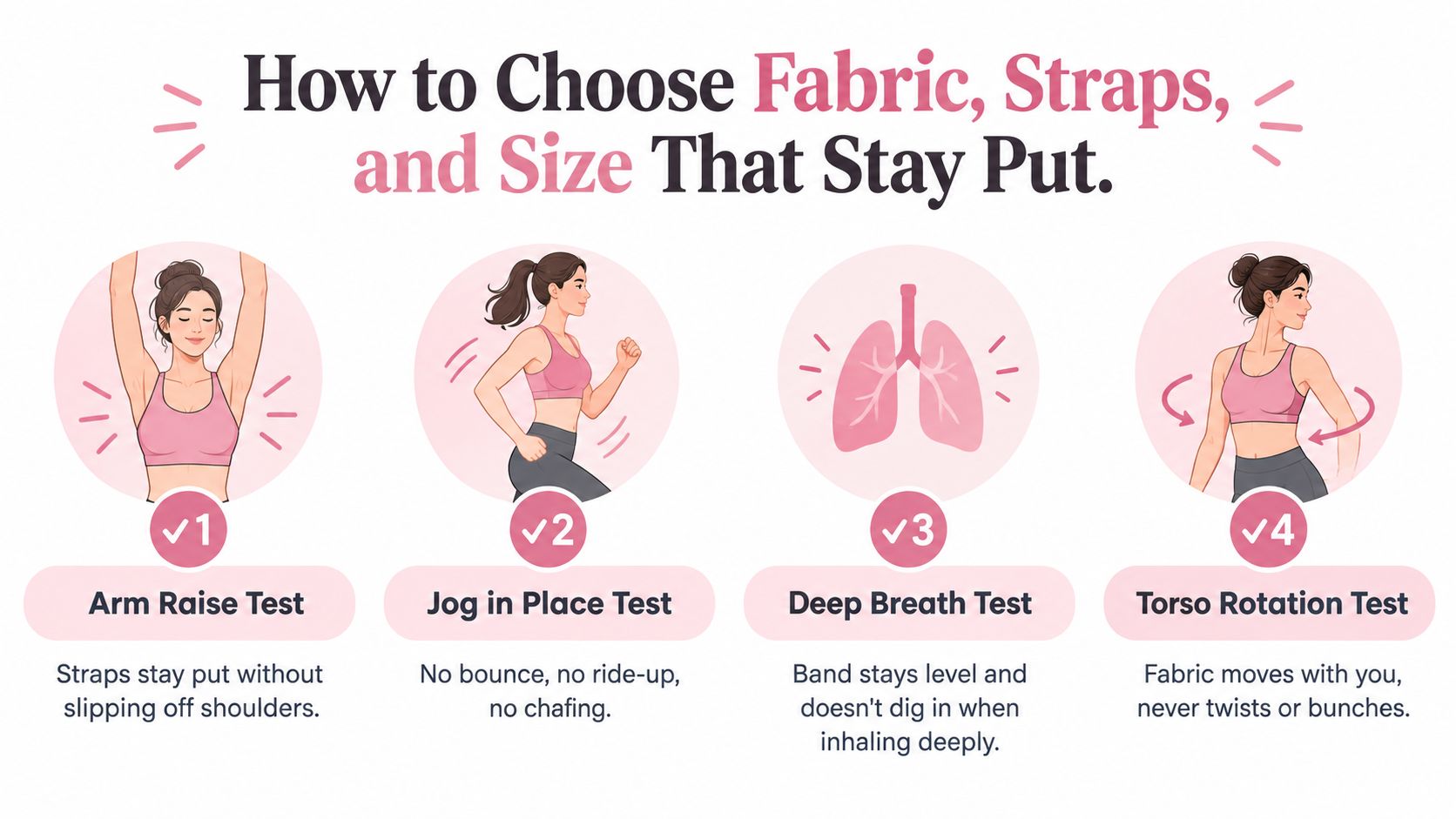
- Raise your arms. Reach overhead and lower them slowly. Straps shouldn't slip off, and the band shouldn't climb toward your ribs.
- Jog in place. Keep the test gentle but realistic. Look for breast containment, a stable band, and any rubbing at the under-bust fold or side seams.
- Take a deep breath. Your ribs need room to expand. A close fit is acceptable, but sharp digging or a band that feels restrictive means the pressure is in the wrong place.
- Rotate your torso. Turn side to side and bend slightly. Fabric should follow your body rather than twist into a rope across your back.
The word snug describes even, distributed contact. It doesn't describe numbness, painful compression, or a strap that leaves a deep groove within a short try-on. If the cups spill at the top or sides, changing only the strap length won't fix containment. If the back rides up, the underband may be too loose or the torso length may not suit the pattern.
Read the fabric like a comfort tool
Mesh can improve airflow when it appears in useful zones, such as the center back or areas that collect heat. Smooth, flat seams can reduce friction, while a soft edge around the underband can make a close fit easier to tolerate. Fabric content matters too, but fiber labels can't replace a movement test.
Drying behavior deserves its own check. Controlled testing at 23°C and 50% relative humidity found drying times of 13 to 66 minutes for compression bras, 25 to 42 minutes for encapsulation bras, and 35 to 43 minutes for combination bras. Measured moisture uptake ranged from 6 to 15%, 13 to 15%, and 7 to 19%, respectively, as reported in this controlled sports-bra drying study. Construction and fiber composition work together, so a supportive bra can still feel clammy after exercise.
For a more detailed look at racerback comfort and shoulder freedom, explore this guide to comfortable racerback bras. Choose the navy colorway you'll wear, because dyeing and finishing can alter fabric mass, surface behavior, and drying characteristics. Color shouldn't be assumed to be performance-neutral without checking the finished garment.
Navy Sports Bra Outfit Ideas for Workout to Weekend
A navy sports bra earns extra value when it works beyond one class. Treat it as the quiet anchor of an outfit. It can provide a clean dark base while the surrounding layers change the mood.
Made to Move
Pair the bra with matching or tonal navy leggings, then add a loose mesh or lightweight tank. The darker base keeps the look polished, while a breathable outer layer gives you more coverage without trapping the same heat against your skin. White trainers or a pale cap can brighten the outfit without competing with the navy.
Desk to Dinner
For a work-to-evening transition, wear the bra beneath a relaxed white shirt or an open overshirt with well-fitted trousers. Let a small section of the neckline show if the bra has a clean finish, or button the shirt higher for a more understated effect. A structured blazer changes the silhouette quickly, while the close-fitting base prevents extra fabric from bunching underneath.
Off-Duty Soft
Combine navy with washed denim, a soft cardigan, and relaxed bottoms. This works especially well when the bra has smooth edges and a neckline that sits neatly beneath the top layer. Keep the palette calm with cream, gray, muted blue, or warm tan.
The same bra can look athletic, polished, or relaxed because the layers do the styling work. A useful video reference can help you visualize navy sports-bra outfit combinations before you build your own rotation.
A small color lesson
Navy doesn't have to match every item exactly. Tonal blues create a coordinated look, while white adds contrast and denim makes the color feel casual. If you're wearing the bra as a visible layer, check the neckline and arm openings first. The outfit should reveal the garment deliberately, not because a strap shifted during the day.
How to Keep Your Navy Sports Bra Fresh and Chafe Free
Sweat, friction, fit, and laundry form one comfort system. A bra can feel smooth at the start of a workout and still cause irritation when moisture softens the skin and repeated movement concentrates pressure in one area.
Bra-related chafing affects approximately 20% of female athletes, and contributing factors include poor fit, abrasive textiles, sweating, climate, long exercise duration, and contact with heart-rate-monitor straps, according to this dermatology report on bra-related chafing. Navy may hide visible sweat marks, but it can't make damp skin less vulnerable.
Follow a simple dryness protocol
- Inspect the friction zones. Check the underband, straps, side seams, and under-bust fold after wearing. Redness that follows a narrow edge suggests pressure or seam friction.
- Change after heavy sweating. Don't keep a saturated bra on for the rest of a desk day, travel segment, or errand run if your skin feels damp or irritated.
- Separate pressure from fabric problems. A stable red line in one place often points to compression or edge pressure. Broader roughness, stinging, or irritation along a textured area may indicate textile friction or moisture.
- Check equipment contact. A heart-rate-monitor strap can create a second rubbing point across the chest, especially during a long session.
Wash the bra according to its care label, use enough detergent to remove sweat without leaving a coating, and skip fabric softener when it interferes with absorbency or surface performance. Rinse thoroughly, reshape the cups and band, and let the garment dry fully before storing it. Incomplete drying and repeated wear without washing can undermine odor and moisture management.
For a gentle laundering routine that protects stretch fabrics, use this guide to washing underwear. Travel with a clean, dry spare when possible, especially in humid conditions. Airflow and a complete dry are more useful than relying on navy to conceal what the fabric has absorbed.
Find Your Stay Put Navy Match and Move With Ease
Choose your next navy sports bra by naming the movement first. If you run or jump, begin with containment, band stability, and a cup structure that manages motion. If you lift, rotate, and reach, prioritize support that stays centered without restricting your ribs. If your day blends commuting with light activity, weigh softness, drying behavior, and layering as carefully as support.
Then perform the four-movement check. Raise your arms, jog gently, breathe, and rotate. A bra that passes those tests should feel secure without asking your shoulders, neck, or ribs to compensate.
Keep the rest of the system practical:
- Support: Look beyond low, medium, and high labels.
- Fit: Check the band, cups, straps, and torso length together.
- Fabric: Consider airflow, moisture uptake, seams, and drying.
- Care: Wash away sweat and detergent residue, then dry completely.
- Style: Use navy as a flexible base, not as evidence of performance.
If you're caring for technical stretch garments alongside your bra, this Thermo Recovery Wear maintenance advice offers useful guidance on preserving performance fabrics. Nuage Wears' comfort-first approach, including breathable mesh and stay-put everyday design ideas, fits naturally into a wardrobe built around movement, layering, and easy care.
Nuage Wears offers comfort-focused bras, bralettes, underwear, and everyday apparel designed around breathable materials, smooth finishes, and stay-put wear. Visit Nuage Wears to find pieces that support your desk-to-workout routine and build your next navy outfit with confidence.


