


You're standing in front of the mirror, tugging down a fitted skirt and turning sideways. The skirt looks great, but now you're checking three things at once: whether a line is visible, whether the waistband is rolling, and whether the pair you put on will become a wedgie halfway through your commute.
That's the core challenge with panties under the skirt. There isn't one universally perfect cut. A thong can disappear under a clingy pencil skirt but feel wrong during a long walk. A full brief can feel secure under a short A-line, yet overheat beneath a light summer midi. The smart choice depends on the skirt's shape, the fabric, the weather, and how much you'll move.
This guide gives you a practical decision system. You'll learn how to match cuts to silhouettes, identify the construction details that cause lines and ride-up, and decide when more coverage helps, and when it traps more heat.
Table of Contents
- The mirror moment every skirt wearer knows
- What actually causes lines, wedgies, and overheating
- Matching underwear cuts to skirt types
- Fabrics and finishes that disappear under skirts
- The fitting room fit test
- Should you even wear underwear under a skirt
- Putting it all together a quick selection guide
- Care that keeps invisible underwear invisible
The mirror moment every skirt wearer knows
You've dressed for work, dinner, or a day out. The skirt is on, the top works, and then the mirror inspection begins. You sit down, stand up, twist, lift one knee, and smooth the fabric over your hips. A waistband edge appears where it shouldn't. A seam creates a faint ridge. The underwear feels fine for thirty seconds, but you already know it'll shift once you start walking.
Those problems usually fall into three categories:
- Visibility: an edge, seam, or thick waistband prints through the skirt.
- Movement: the leg opening rides up, the back shifts, or the gusset pulls.
- Heat: fabric and elastic trap moisture during commuting, walking, or sitting.
The mistake is choosing underwear by cut alone. “Thong” doesn't automatically mean invisible, and smooth designs don't automatically mean comfortable. A poorly fitted thong can move more than a smooth hipster, while a plain brief can still feel damp if its knit is dense and slow to dry.
The useful question: What problem must this pair solve under this specific skirt?
Start with the outfit, not the product label. A fitted skirt asks for low-profile edges. A short skirt may make stable coverage more important than absolute invisibility. A loose, breathable skirt gives you permission to prioritize softness and airflow.
The rest of your decision becomes much easier once you identify the failure you're trying to prevent. You're not searching for the “best panty.” You're choosing the least annoying construction for the job.
What actually causes lines, wedgies, and overheating
Panty lines, wedgies, and overheating come from different mechanisms. Diagnose the mechanism first, then choose the cut.
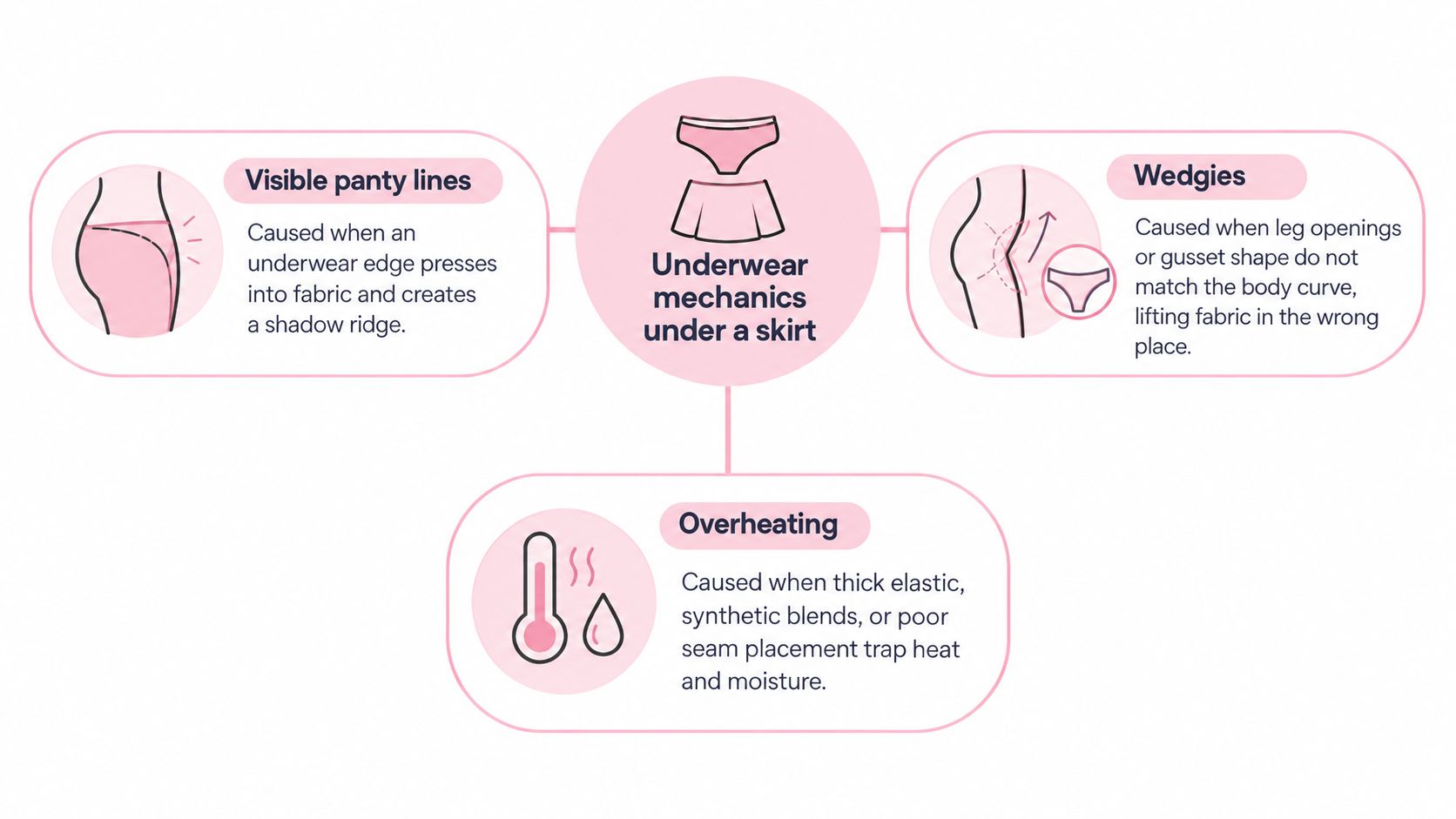
Visible lines come from pressure and thickness
A visible panty line forms when an edge, seam, or thick waistband presses against the outer skirt and creates a ridge or shadow. The problem becomes more obvious under fitted or clingy fabrics, which transfer the underwear's shape instead of disguising it. Color matters, but construction matters more. A nude pair with a raised edge can show more than a darker pair with a flat finish.
Wedgies are a movement problem
Walking repeatedly creates shear and friction between your body, underwear, and skirt. If the leg opening doesn't recover well, the gusset is poorly shaped, or the cut is too small, the fabric can shift toward the body and stay there. The result may be a classic wedgie, a leg edge that rides upward, or constant adjusting that ruins an otherwise good outfit.
Static fit checks aren't enough. Walk, sit, climb stairs, and bend at the hips. A pair that stays in place while standing may fail as soon as your stride length and posture change.
Overheating is a textile issue
Softness alone doesn't determine thermal comfort. Air permeability, water-vapor permeability, liquid-moisture transport, thermal resistance, and drying time all influence how warm and damp a next-to-skin layer feels. Textile researchers also assess wetting time, spreading speed, absorption rate, one-way transport, and Overall Moisture Management Capacity, or OMMC, which ranges from 0 to 1. A higher-performing next-to-skin layer moves perspiration away from the skin and toward the outer surface, helping reduce the damp microclimate associated with heat, friction, and irritation. Moisture-management research explains why fabric thickness, porosity, density, and knit structure matter alongside the fiber name.
For a broader lifestyle approach to choosing practical everyday products, ArtNaturals picks for affordable beauty offers a useful reminder: judge the actual design and use case, not just the label. Apply that same rule here. “Soft,” “smooth,” and “breathable” are starting points, not proof.
Matching underwear cuts to skirt types
Start with the skirt, then choose the cut. A tight skirt needs a lower-profile panty. A looser skirt gives you room to choose more coverage, but movement, heat, and the fabric's surface still decide what works.
| Skirt type | Best cut | What it solves |
|---|---|---|
| Mini or bodycon | Laser-cut thong or smooth-finish hipster | Reduces visible edges while keeping the outline clean |
| A-line or pleated | High-rise brief or smooth hipster | Adds coverage and stability without fighting a relaxed silhouette |
| Fitted pencil or midi | Laser-cut thong or bonded high-rise brief | Balances low visibility with secure placement |
| Flowy, textured midi, or wrap | Soft brief or boyshort | Prioritizes comfort, coverage, and movement confidence |
Mini and bodycon skirts
Mini and bodycon skirts put every edge on display. If the skirt clings to the hips and seat, choose a laser-cut thong. If you hate thongs, a smooth-finish hipster with a flat edge is the better backup, because thick elastic prints fast under fitted fabric.
For a short, looser mini, coverage matters more than perfect invisibility. A smooth brief or boyshort can feel steadier when you sit, bend, or deal with wind. Keep the leg opening soft and low-profile, because a tight edge can leave a clear horizontal line and still creep into a wedgie if it grabs the skin.
A-line and pleated skirts
A-line and pleated skirts give you more room to work with. A high-rise brief fits well when the skirt sits at the natural waist or above it, especially if you want the waistlines to line up instead of fighting each other. A smooth hipster is the middle ground when the pleats skim the body but do not cling.
Skip bulky lace and thick waistbands under thin pleats. The skirt may feel relaxed, but movement can still press texture into the hips and make the underwear shape show through. For a cleaner cut discussion, thongs versus cheekies is the right comparison to keep in mind.
Pencil and fitted midi skirts
A pencil skirt or fitted midi needs the cleanest possible line over the hips and seat. A laser-cut thong keeps the number of edges to a minimum. If you want fuller coverage, choose a bonded high-rise brief with a smooth front and leg openings that stay put without digging in.
The rise matters here. A low-rise pair under a higher skirt can roll or leave a pressure line across the stomach. A high-rise pair that sits too high can bunch under the waistband. Match the two waistlines instead of trusting the label on the underwear.
Flowy, textured, and wrap styles
Flowy and textured midis are the easiest to dress. A soft brief or boyshort works because the skirt's movement and surface hide small edges. Wrap skirts need a little more attention, since sitting and walking can shift the overlap and make coverage less predictable.
If thigh chafing is your main problem, fuller coverage can help by reducing skin-on-skin contact. More fabric is not automatically better, though. A dense, damp boyshort can trap heat and shift if the leg openings do not recover well. Pick the cut that solves the problem, then ignore the marketing promise that every skirt needs the same panty.
Fabrics and finishes that disappear under skirts
The fiber name tells only part of the story. The knit, edge treatment, waistband, gusset, and moisture behavior determine whether underwear stays unnoticeable in real life. Choose them around the skirt, the weather, and how long you will wear it.
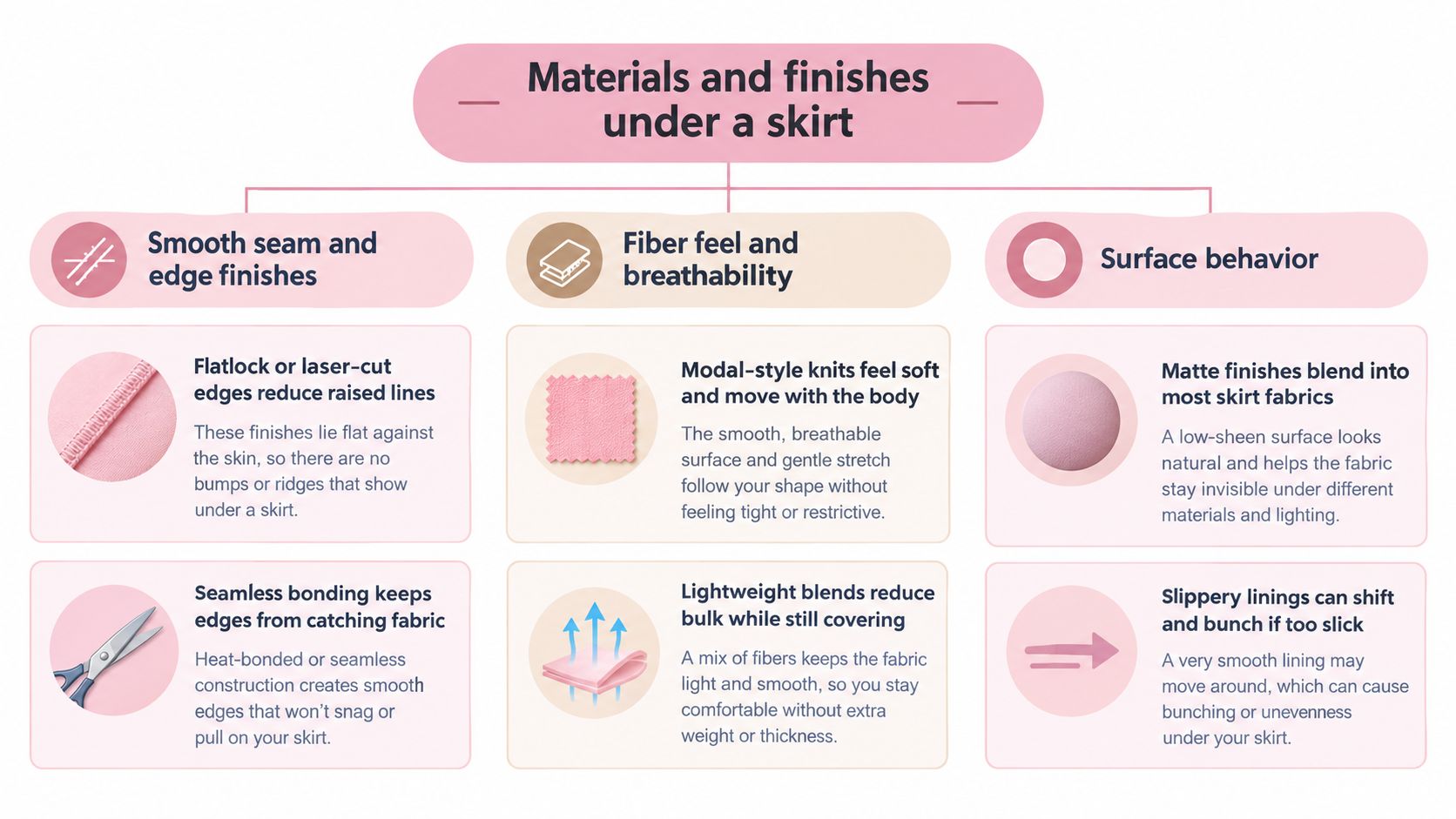
Modal-style knits feel soft and flexible, so they suit relaxed daily wear. Microfiber and nylon-spandex blends create a smooth, close-to-skin surface that works under fitted skirts. Mesh can release heat, but dense layers or trapped moisture can cancel that benefit. For a hot commute, prioritize drying and stability over the airiest-looking fabric.
Look at the edges first
Laser-cut and raw-cut edges reduce the raised ridge that fitted fabric can reveal. Bonded waist and leg bands may lie flatter than stitched elastic, as long as the fit spreads pressure instead of gripping one narrow area. Under a pencil skirt, that difference matters more than a soft fabric label.
Flat construction still needs enough recovery to return to place after stretching. An edge that stays loose can roll or creep upward, creating a wedgie. An edge pulled too tightly can press into the skin and show through the skirt. Test both problems while walking and sitting, not only while standing.
Use mesh strategically
Targeted mesh zoning works better than covering the whole garment in a delicate open knit. Put airflow where heat and moisture collect, while keeping the gusset and high-friction areas smooth and stable. For daily wear, a lightweight knit with sensible ventilation may feel better than fabric that shifts every time you move.
Moisture handling depends on air permeability, water-vapor resistance, drying time, and OMMC. Treat “breathable” as a construction question, not a promise on the packaging. If you are comparing cotton options, The Fabric Company's cotton guide explains how fiber choice and garment construction work together.
Don't trust the label by itself
A pair marketed as smooth can still roll at the waist, grip the leg, or retain moisture. A thick panel without visible stitching may cast a larger shadow than a thin, carefully placed seam. For a closer explanation of construction, read this guide to how smooth underwear construction works.
Check the complete garment:
- Edge profile: Does the finish feel flat under your fingers?
- Recovery: Does it return to shape after stretching?
- Gusset: Does it stay centered without pulling?
- Surface: Is the fabric matte and stable, or too slippery?
- Moisture behavior: Does it dry quickly after washing and wear?
A cotton or silk-blend gusset can help where moisture control matters, while a smooth synthetic outer body can reduce bulk beneath the skirt. Choose the combination that matches your sensitivity, activity, climate, and skirt fabric.
The fitting room fit test
A pair can have the perfect fabric and still fail because the rise, gusset, or leg opening doesn't match your body. Run this test before trusting new panties under a fitted skirt.
Four checks before you leave the mirror
- Match the rise. The panty should sit where the skirt waistband sits. If the skirt is high-rise and the underwear is low, you may feel rolling or pressure across the middle. If the panty rises too far, its top edge may show beneath a slim waistband.
- Check the leg opening. Stand naturally and look for gripping, wrinkling, or a deep indentation. The edge should lie flat without cutting into the thigh or leaving a loose channel where it can migrate.
- Test the gusset. The gusset should stay centered and wide enough to remain stable while you move. If it pulls forward or backward, the garment's shape isn't matching your body.
- Do the sit-stand test. Sit, stand, bend, and lift one knee. A waistband that rolls immediately is too loose, too tight, or poorly matched to your torso.
“Bonded” means the layers are joined with adhesive or heat-based construction rather than a conventional bulky seam. “Recovery” describes how well stretch fabric returns to its original shape after tension. Neither term guarantees comfort, so test the actual pair.
Walk across the room, climb stairs, and flex your hips. Record what happens mentally: does the edge shift, roll, ride up, or create pressure? Garment-pressure models can help predict fit, but physical validation still matters because body geometry, fabric elasticity, garment tension, and posture change the result. Research on garment pressure and virtual fit supports treating movement testing as essential rather than optional.
Use this video as a visual companion while checking how underwear behaves during movement:
Should you even wear underwear under a skirt
You don't have to treat underwear as a universal health requirement. The better question is whether the garment improves comfort, coverage, moisture management, or confidence in the situation you're in.
Going without can be reasonable at home, under a loose skirt, or at bedtime if that feels more comfortable. A loose skirt can reduce pressure and trapped heat, and some people prefer the airflow of going without. It's a personal comfort choice, not a rule that everyone needs to follow.
Underwear becomes more practical during a long commute, menstruation, noticeable discharge, public seating, or an outfit that shifts while you walk. A breathable pair can provide a washable barrier and help you feel more secure. For a tight pencil skirt, underwear may also prevent direct skin friction from becoming the main problem.
Separate thigh comfort from vulvar comfort
A boyshort can reduce skin-on-skin rubbing at the thighs, but its fuller coverage may also add heat around the gusset. A thong may reduce fabric bulk but offer no help against external thigh chafing. Those are different problems, and one garment may not solve both.
Clinical vulvar-care guidance recommends minimizing tight garments and irritating seams, changing underwear when needed to control wetness, and sometimes going without underwear at home. This vulvar-care guidance also supports judging comfort by pressure, moisture, and irritation rather than assuming a particular cut is always healthier.
Mayo Clinic guidance similarly recommends loose clothing, avoiding overly tight panties, washing underwear with mild detergent, and changing it as needed. It notes that going without underwear at bedtime or wearing loose skirts can be reasonable for some people. Mayo Clinic's feminine-hygiene guidance is especially useful because it keeps the advice practical rather than product-driven.
Persistent itching, odor, pain, or unusual discharge isn't a sign that you need a different color or cut. Those symptoms need medical evaluation.
Putting it all together a quick selection guide
Use this decision tree before getting dressed:
- If the skirt is fitted or clingy, choose a laser-cut thong or hipster in a smooth modal-style knit or microfiber construction.
- If the skirt is structured or midi-length, choose a bonded high-rise brief when you want coverage, especially for a long day.
- If the skirt is loose and breathable, choose a soft modal brief or hipster and prioritize comfort over absolute invisibility.
- If you'll walk, travel, or sit for hours, prioritize stable recovery, soft edges, and moisture management.
- If it's hot or active, choose targeted mesh zoning and a stay-put cut rather than automatically choosing the fullest coverage.
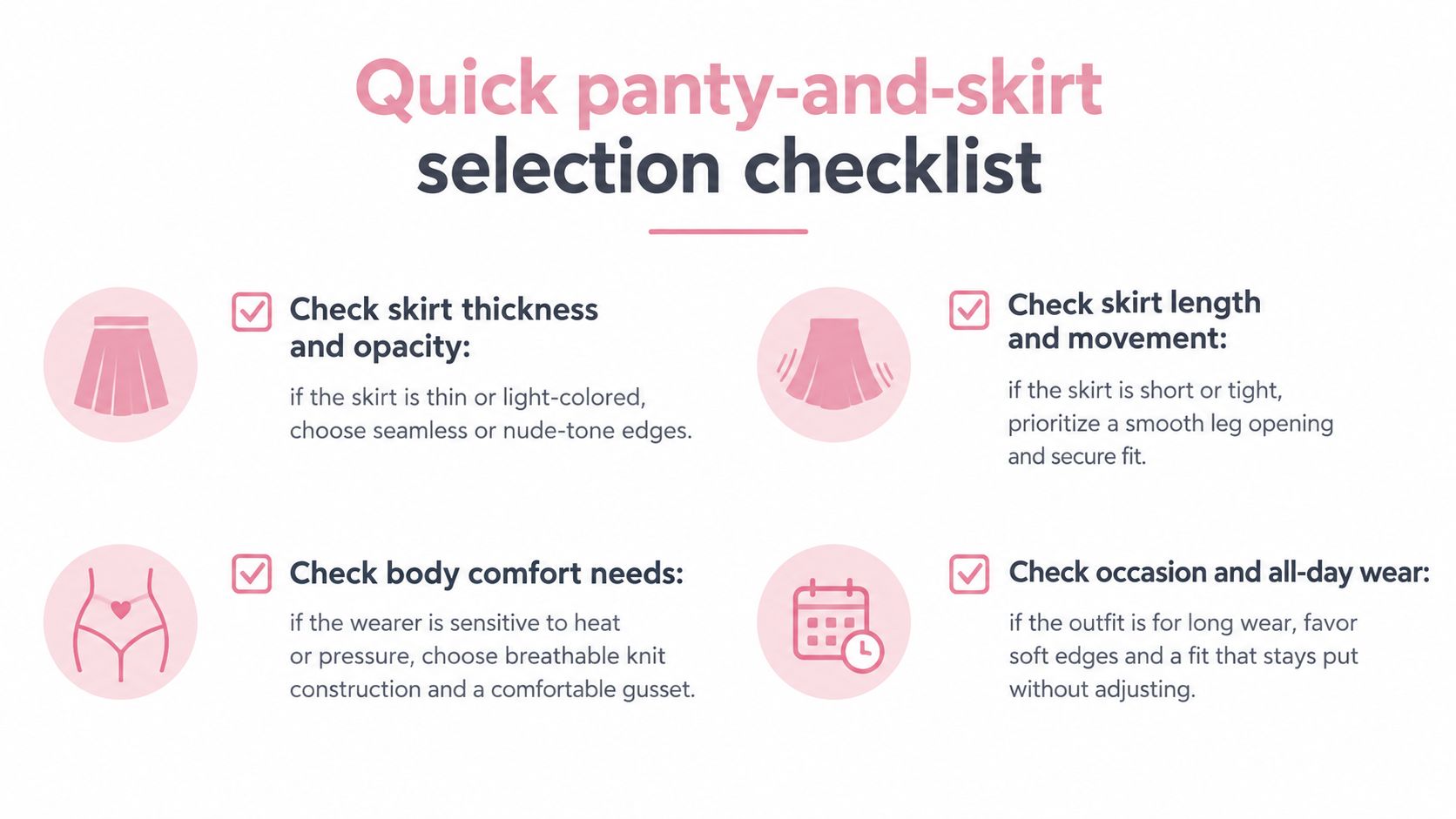
| Outfit context | Top priority | Cut to reach for |
|---|---|---|
| Fitted skirt and thin fabric | Minimal edges | Laser-cut thong |
| Workday midi | Stable, breathable coverage | Bonded high-rise brief |
| Hot commute | Airflow and recovery | Mesh-zoned hipster or brief |
| Short A-line | Movement confidence | Smooth brief or boyshort |
| Loose, soft midi | Skin comfort | Modal brief |
Care that keeps invisible underwear invisible
Care can undo good construction quickly. Wash delicate pairs cold, skip fabric softener on bonded and laser-cut styles, and air-dry or tumble-dry low. Rotate between pairs so the elastic has time to recover instead of stretching the same few garments every day.
Fabric softener can coat fibers and interfere with mesh's moisture behavior. Excess heat can weaken bonded construction and accelerate the loss of stretch recovery. A lingerie bag can reduce snagging, especially for mesh and raw-cut edges.
The drawer checklist
- Wash cold: Protects stretch and delicate finishes.
- Skip softener: Keeps fibers and mesh from becoming coated.
- Dry gently: Air-dry when practical, or use low heat.
- Rotate pairs: Gives elastic and bonded areas time to recover.
- Inspect edges: Retire pairs when the finish rolls, peels, or loses stability.
For more general guidance on how to protect your finished garments, focus on reducing heat, friction, and harsh treatment. The same principle keeps skirt underwear smoother for longer.
Nuage Wears offers modal briefs, laser-cut no-visible-lines styles, bonded stay-put cuts, and mesh-zoned options for everyday wear, travel, and active days. Choose your skirt first, identify the problem you need to solve, then explore Nuage Wears for a cut built around that specific comfort need.


