


You're standing in front of a half-empty closet on a Tuesday morning, already late, and the same black trousers are the only pair you trust. They've handled meetings, dinners, travel days, and last-minute plans without demanding much thought. That reliability is exactly why black pants remain such a useful wardrobe foundation.
The catch is that black isn't a fit strategy. A dark color can't rescue fabric that turns sheer when stretched, a waistband that digs when you sit, or a cut that fights your shoes. The strongest pair combines the right silhouette, fabric density, stretch, opacity, and rise for the way you'll wear it.
Table of Contents
- Why Black Pants Earn a Permanent Spot in Your Closet
- The Core Silhouettes Worth Knowing
- How Fabric Choice Changes Everything
- Getting the Fit and Tailoring Right
- Dressy Versus Casual Black Pants Compared
- Outfit Ideas for Work, Weekends, and Evenings
- The Opacity Myth and Other Buying Traps
- A Quick Pre-Buy Checklist Before You Commit
Why Black Pants Earn a Permanent Spot in Your Closet
A black trouser can carry you from a morning meeting to dinner, but its usefulness starts with construction rather than color. Check whether the fabric stays opaque when stretched, whether its weight suits the season, and whether the cut leaves room to sit and move. A dark shade only works as a wardrobe foundation when the garment itself performs well.
Black pants coordinate easily with pieces already in your closet. A white shirt looks crisp against them, a bright sweater feels deliberate, and a patterned jacket gains a calm base. That flexibility makes one well-chosen pair more practical than several pairs reserved for a single occasion.
They also earn their place on travel days and long workdays. A polished trouser can suit loafers in the morning, then change direction with another top and a dressier shoe at night. A softer ponte or stretch-cotton pair can replace jeans while still looking considered enough for errands, casual lunches, and informal workplaces.
The wider women's trousers market reflects how often pants serve as wardrobe basics. One industry estimate valued the global market at USD 211.95 billion in 2021 and projected USD 293.06 billion by 2028, with a 4.7% compound annual growth rate. Europe represented more than 30% of global market share in 2021, a pattern consistent with trousers' role in workwear and formal wardrobes across major markets. Read the women's trousers market estimate
Practical rule: Choose black pants for the life you lead, not for the fantasy wardrobe you might build someday.
A later market estimate placed the category at USD 261.45 billion in 2025 and projected USD 397.33 billion by 2034, with Asia Pacific holding 38.6% of revenue in 2025. The figures point to the same buying lesson: women's pants are recurring wardrobe basics, so prioritize pairs you will wear repeatedly.
This guide approaches black pants womens shoppers wear as a fabric-and-fit problem first, style problem second. You'll learn how opacity, weight, stretch, rise, silhouette, tailoring, and outfit context affect a pair before you decide whether its color alone makes it worth buying.
The Core Silhouettes Worth Knowing
Start with the outline, because the silhouette determines how the garment sits over your hips, thighs, knees, and ankles.
- Straight-leg: Falls in a fairly even line from hip to hem. It's the neutral baseline and often creates a long, uninterrupted shape without clinging to the leg.
- Wide-leg: Roomy from the hip or upper thigh down. It gives you movement and visual drama, while a high waist can make the torso-to-leg proportion look longer.
- Barrel-leg: Curves outward through the thigh and then narrows toward the ankle. This cut adds shape and ease, especially when a narrow trouser feels restrictive.
- Slim and skinny: Close to the body through most of the leg. They show more contour, so fabric recovery, pocket placement, and undergarment lines matter more.
- Bootcut: Stays relatively close through the thigh and opens gently below the knee. The small hem expansion can balance fuller hips or thighs and sits neatly over a low boot.
- Flare: Opens more noticeably from the knee. It creates a stronger line and usually needs enough hem length to meet the shoe rather than stopping above it.
- Tapered: Offers room through the thigh and narrows toward the ankle. Think of it as a relaxed upper leg with a cleaner, slimmer finish below.
- Cropped: Ends above the ankle. It shows more shoe and can work well with flats, sneakers, or ankle boots, though the exact stopping point changes the visual proportion.
- Ankle-length: Finishes around the ankle bone. This is a useful middle ground for showing footwear without creating the sharper break of a crop.
- Full-length: Reaches the top of the shoe or falls slightly over it. It usually gives the most continuous leg line and works especially well with wider hems.
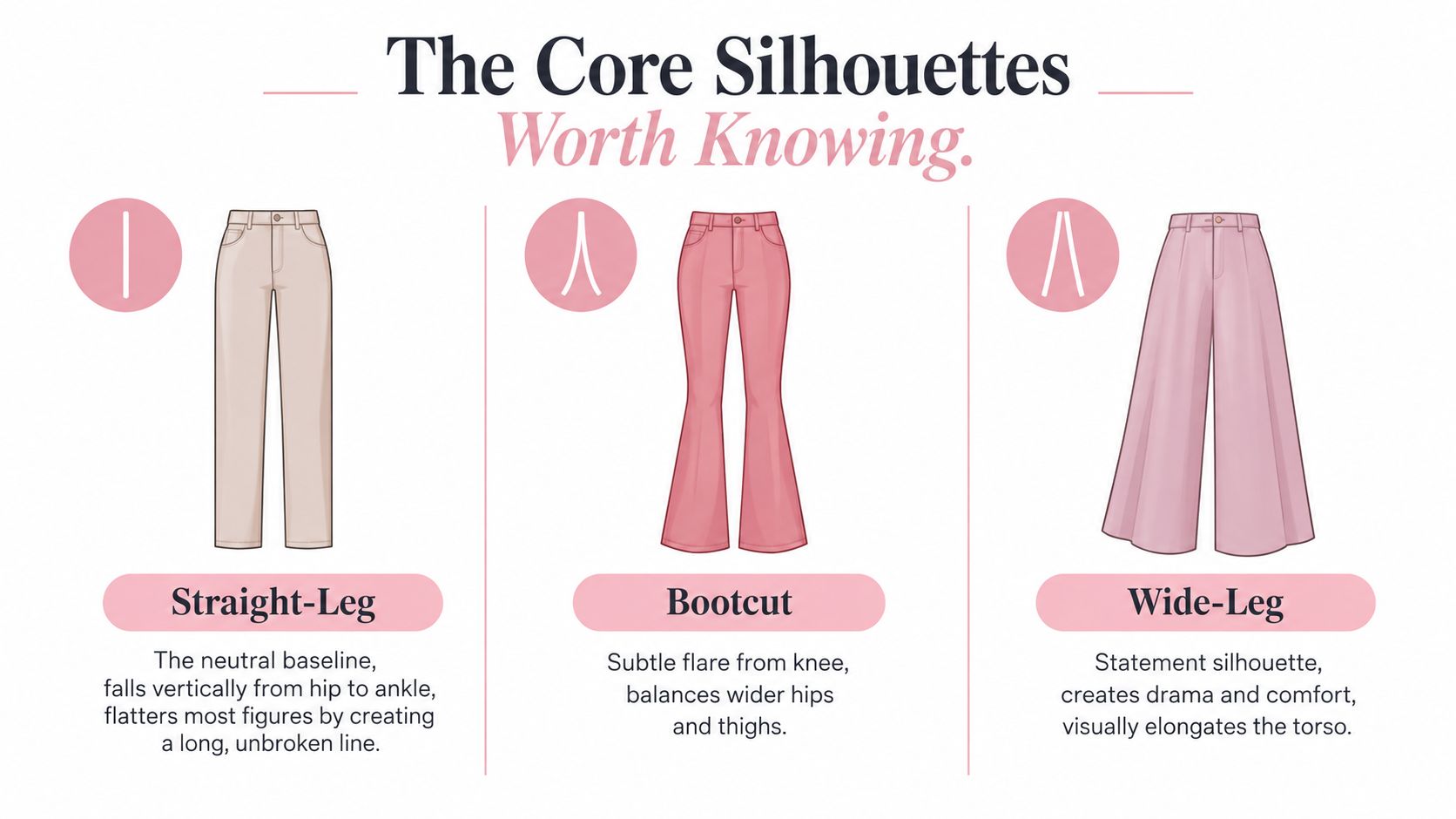
A straight-leg pair is the safest starting point if you're unsure. Wide-leg and barrel-leg cuts offer more room, while slim, skinny, bootcut, and flare styles make a stronger statement about shoes and proportion. If you're choosing between a relaxed pair and something designed for downtime, you can also compare the role of lounge wear pants in your wardrobe.
Silhouette is where many fit problems begin. A waistband can be perfect while the thigh is too tight, or the hips can fit while the ankle opening looks wrong with your shoes. Decide the shape before judging the fabric, because the same material behaves very differently in a narrow cut than in a roomy one.
How Fabric Choice Changes Everything
A black pant can look polished or disappointing before the cut even enters the conversation. Start with three fabric variables: weight, weave, and stretch. Color gives the surface its appearance, while construction controls whether the garment hangs cleanly, keeps its shape, and remains opaque as you move.
GSM, or grams per square meter, helps compare fabric weight. As a practical guide, material under 200 GSM generally feels light, 200 to 300 GSM usually feels midweight, and fabric above 300 GSM tends to feel more structured. These ranges describe feel and behavior, not quality. A lighter fabric can suit warm weather, while a heavier one often gives steadier drape and more coverage.
For close-fitting stretch garments, 150 to 200 GSM is commonly treated as a minimum range for solid opacity. Heavier double-knit or high-density constructions above 200 GSM generally provide stronger coverage and recover their shape more reliably during movement. Review guidance on stretch fabric weight and opacity
How weave changes the result
| Fabric | Typical GSM | Stretch | Best For |
|---|---|---|---|
| Wool suiting | Mid to heavy | Low to moderate | Formal trousers and office tailoring |
| Ponte | Mid to heavy | Moderate to high | Comfortable polished outfits |
| Twill | Light to mid | Low to moderate | Casual trousers and travel |
| Crepe | Light to mid | Low to moderate | Dressy drape and evening outfits |
| Gabardine | Mid to heavy | Low to moderate | Structured workwear |
| Jersey | Light to mid | Moderate to high | Relaxed pieces, with opacity checks |
A tight weave, thicker yarn, or denser fiber arrangement blocks more light. A loose knit or thin yarn can open under tension, so pants that look opaque on a hanger may reveal more at the knee, seat, or thigh once worn. Learn how fabric construction affects opacity
Stretch should make movement easier, not determine the entire fit. A little elastane or spandex can support sitting, walking, and bending. Too much stretch in a light fabric may cause clinging, weak recovery, or a line that loses its shape.
Use a bright-light test before buying. Hold the fabric toward the light and stretch it flat. Then bend or squat while checking whether the black surface turns gray, reveals skin tone, or exposes the outline of seams. That quick test often tells you more than color alone.
Getting the Fit and Tailoring Right
Measure your body before you trust a size chart. Brand sizing varies, and a garment's rise, fabric recovery, and intended ease can change how the same labeled size feels.
Take four useful measurements
- Waist: Wrap the tape around the narrowest point of your torso, keeping it level and comfortably close.
- Hips: Measure around the fullest part of your hips and seat. Keep the tape parallel to the floor instead of pulling it upward at the back.
- Inseam: Measure from the crotch seam to the ankle bone or the point where you want the hem to finish.
- Rise: Measure from the crotch seam to the top edge of the front waistband.
Record each measurement in inches and centimeters. That makes online comparisons easier when one size chart uses one system and another uses the other.
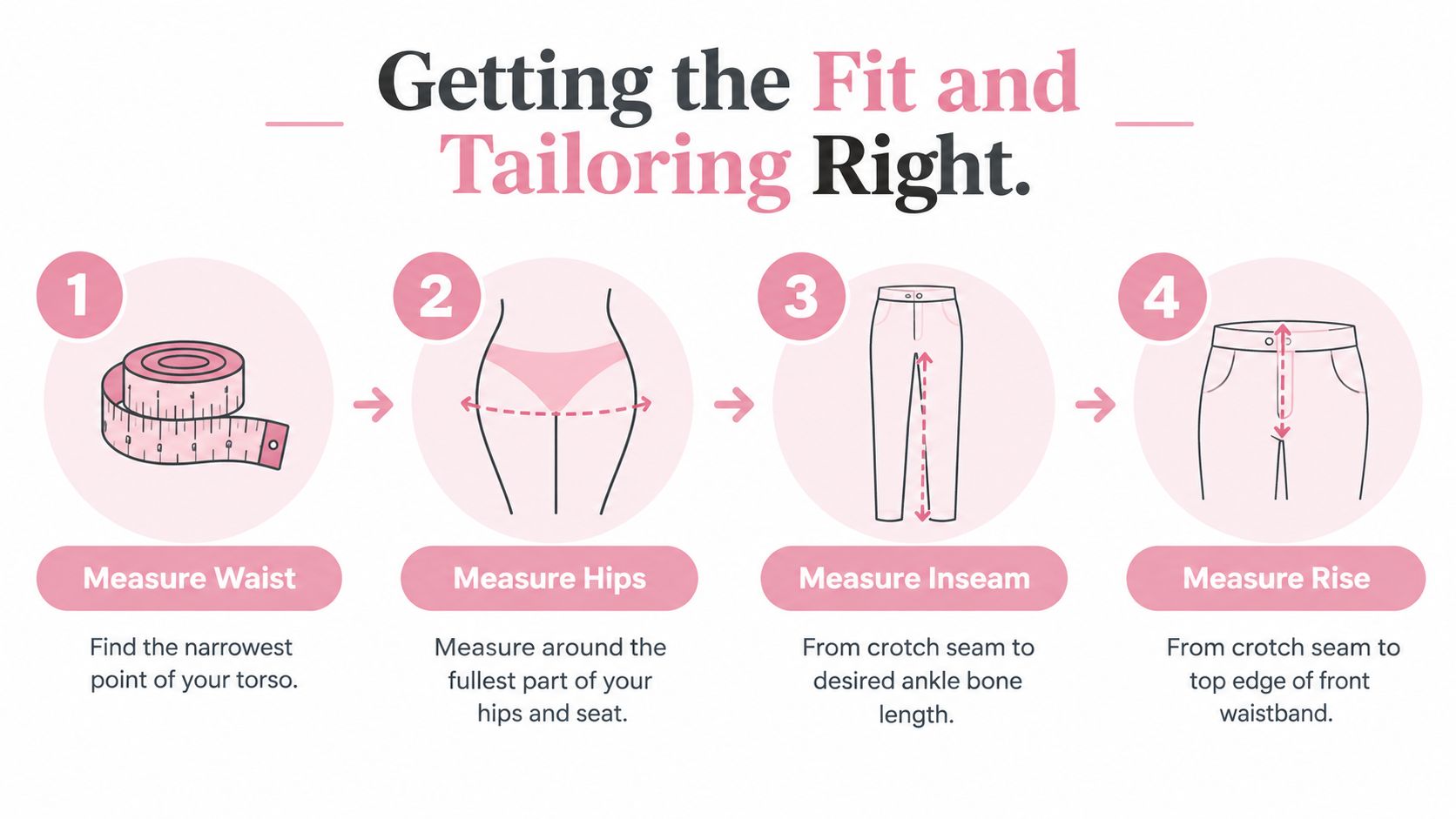
At the waist, look for a band that lies flat without cutting in. You need a little ease so the waistband remains comfortable when you sit, but excessive room creates gapping and makes the trousers slide. At the hip, the fabric should pass smoothly over the fullest point. Pull lines radiating from the fly or pockets usually signal tension, while pooling below the seat can indicate excess fabric or an incorrect rise.
Let rise and length shape the outfit
Low-rise pants can work well on shorter torsos, while mid-rise styles suit many wardrobes. High-rise pants lengthen the visual leg line and sit neatly beneath tucked knits, shirts, and blazers. Choose based on where you want the waistband to rest, not just on the current trend.
Inseam controls the relationship between the hem and the shoe. Taller shoppers should check for long lengths rather than assuming a larger size will add leg length. Also inspect the back yoke and pocket placement, since both can change how the seat appears.
A near-perfect pair may only need a tailor. Hemming, waist suppression, and seat tapering can turn an almost-right fit into a dependable one, especially when the fabric and construction justify the alteration.
A short movement test reveals more than standing in front of a mirror. Sit, walk, bend, and raise one knee. Notice whether the waistband rolls, the crotch pulls, or the side seam rotates toward the front.
Dressy Versus Casual Black Pants Compared
Dressy and casual black pants can both work well, but they solve different wardrobe problems. Start with fabric and construction, then choose the style. Dressy trousers hold a clean line through denser materials and firmer structure. Casual pairs put movement, softness, and everyday details first.
| Attribute | Dressy Black Pants | Casual Black Pants |
|---|---|---|
| Fabric | Wool blends, gabardine, heavy crepe | Ponte, twill, stretch cotton, denim, jersey |
| Structure | Structured waistband, fly front, pressed crease | Elastic waistband, drawcord, relaxed construction |
| Surface | Smooth and refined | May include seams, texture, or denim character |
| Common cuts | Straight, slim straight, cut wide-leg | Barrel, jogger, relaxed wide-leg |
| Pockets | Slash or welt pockets | Patch, cargo, or more visible pockets |
| Styling | Blouses, blazers, pointed shoes | Tees, sweaters, hoodies, sneakers, loafers |
Dressy black pants earn their polished appearance from three details: opacity, weight, and finish. A dense fabric should cover the body without becoming bulky, while a flat waistband and secure pockets keep the front smooth. A pressed crease sharpens a straight or wide-leg shape. Smooth crepe can look refined while feeling less rigid than traditional suiting.
Casual black pants can still appear considered. Ponte has a soft, substantial hand, stretch cotton feels familiar against the skin, and denim gives a clear everyday signal. Elastic waists, drawcords, cargo pockets, and decorative seams make the outfit look relaxed, even though the black color remains visually strong.
Choose by calendar, not fantasy
Your weekly routine is a better guide than an imagined wardrobe. Meetings, client-facing work, and formal dinners give a well-fitted dressy pair more opportunities to earn its place. Commuting, walking, working from home, and errands favor a softer style that can move with you.
The distinction changes the shoes and surrounding pieces, too. Dressy trousers usually pair with a tucked blouse, blazer, pointed shoe, or polished loafer. Casual pants make more sense with a tee, hoodie, sweater, sneaker, or relaxed loafer.
Neither category is automatically more flattering. The useful question is whether the fabric, opacity, and cut suit the setting and your daily movement. A beautiful pair that stays in the closet takes up space without supporting your wardrobe.
Outfit Ideas for Work, Weekends, and Evenings
One black trouser can change personality through proportion and texture. The trick is to keep the pant's role clear, then adjust the surrounding pieces.
For the office
Start with a slim high-rise trouser in midweight wool. Tuck in a silk camisole or fine knit, then add a structured blazer in a shade slightly lighter than the pants. A low block heel and structured tote finish the outfit without making it feel rigid.
The trouser supplies the long, controlled line. The blazer adds authority through the shoulders, while the softer top keeps the combination approachable. If your workplace is more relaxed, replace the camisole with a fine-gauge knit and use a polished loafer.
For the weekend
Choose a ponte or stretch-cotton barrel-leg pair. Add a boxy white tee, cropped cardigan or chore jacket, white leather sneakers, and a crossbody bag.
The relaxed shape creates room without looking careless. The soft fabric supports movement, and the lighter top gives the black base a fresh contrast. Keep the jacket cropped or close to the waist if you want to preserve the barrel silhouette instead of covering its shape with a long layer.
For the evening
Keep the slim trouser, but remove the office signals. A fitted black top or jewel-tone top adds focus, while heeled mules or strappy sandals make the outfit feel intentional after dark. Statement earrings and a small clutch provide enough shine without requiring a completely new outfit.
The monochromatic base does useful work here. Texture, jewelry, and footwear carry the dress code, so you can look dressed up without adding multiple loud elements.
Styling shortcut: Change the top layer and shoe before changing the pants. Those two swaps often create the clearest shift in occasion.
For travel, favor a fabric that recovers after sitting and a waistband that doesn't press into your stomach. A polished knit or stretch woven can bridge the gap between airport comfort and an arrival outfit, provided it passes the opacity and seat tests described earlier.
The Opacity Myth and Other Buying Traps
Black doesn't automatically look smoother or more flattering. A thin, low-density fabric can reveal panty lines, seams, and contouring precisely because it stretches across the body. A denser weave or heavier knit usually creates the more even surface shoppers expect from black clothing.
The problem often appears only after movement. Fabric can look opaque on a hanger, then open at the knee, seat, or thigh when you bend. A close-fitting black pant may also emphasize wrinkles and seam placement if the construction has poor recovery.
Use a simple three-part test
- Light test: Hold the fabric or a garment section toward a bright window or phone flashlight. Look for visible light patches or a gray cast.
- Movement test: Squat, sit, and walk in front of a mirror. Check the seat, knees, and thighs for pull lines or visible skin tone.
- Surface test: Look at the seams, pockets, and waistband from the side. A good fit should keep them flat rather than forcing them to bulge or rotate.
Lining can help, but a cheap or poorly anchored lining may shift, cling, or create new lines. Pockets deserve equal attention. A pocket that lies flat while standing may bulge as soon as you sit, especially if the hip area is already close.
Stretch fibers can also lose their clean shape over the day when the fabric lacks recovery. Side seams that twist may indicate the garment was cut off-grain or on a bias, which changes how the leg hangs.
For a closer look at the undergarment side of the problem, use this guide to avoid visible panty lines. The right underwear can reduce visible edges, but it can't repair a transparent fabric or an incorrect trouser fit.
The deepest dye isn't the deciding factor. The flattering pair is the one that stays opaque, smooth, aligned, and comfortable while your body moves.
A Quick Pre-Buy Checklist Before You Commit
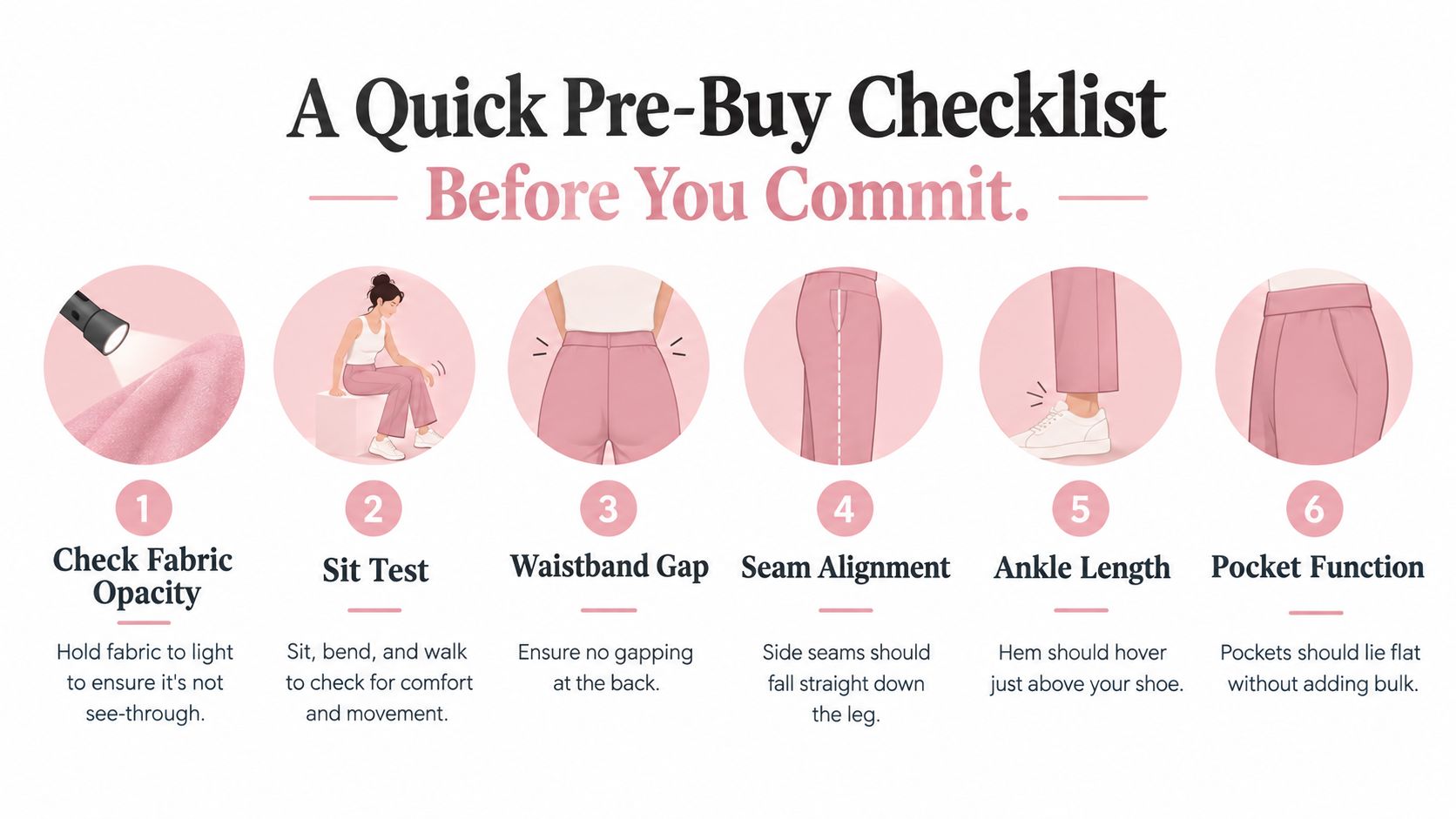
Use this checklist in a fitting room, or repeat it immediately after an online order arrives. The pants need to pass on your body, not just in a product photograph.
- Check fabric opacity: Hold the material toward bright light or a phone flashlight. Look for a gray cast, visible skin tone, or stretched areas that become transparent.
- Run the sit test: Sit, bend, walk, and lift one knee. Notice waistband pressure, crotch pull, and whether the fabric keeps its shape.
- Inspect waistband gap: Turn around and sit down. The back should stay close without gaping or cutting into your waist.
- Confirm seam alignment: Look for side seams that fall straight down the leg. A rotating seam can distort the silhouette and create uneven tension.
- Check the ankle length: Make sure the hem finishes where you intended, whether that's above the shoe, at the ankle bone, or over the top of a shoe.
- Test pocket function: Stand, sit, and move your arms naturally. Pockets should lie flat without adding bulk or pulling the hip area forward.
If you're shopping online, compare your recorded waist, hip, rise, and inseam measurements with the garment chart, then inspect the fabric description for weight, weave, lining, and stretch. Nuage Wears offers comfort-focused underwear and everyday apparel, including laser-cut styles, stay-put cuts, bonded bands, and breathable mesh options that can help you build a smoother, more comfortable foundation beneath fitted black pants. Visit Nuage Wears to explore pieces suited to workwear, travel, and all-day movement.


