


You're in the fitting room, tugging the top edge of a cup back into place, tightening a strap, and smoothing the fabric beneath your arm. The bra looks covered, yet you still feel exposed in one spot and unsupported in another. That frustrating combination is common because full coverage describes how much fabric is present, not whether the bra fits or supports you well.
The better question isn't, “Does this bra cover me?” It's, “Does the construction contain my breast tissue, stay stable against my body, and remain comfortable while I sit, walk, reach, and get through a full day?” Once you look at bras full coverage through that lens, cup height becomes only one part of the decision. Band tension, cup geometry, side panels, center-front contact, and strap placement matter just as much.
Table of Contents
- What Most People Get Wrong About Full Coverage
- Defining Full Coverage Bras and How They Differ
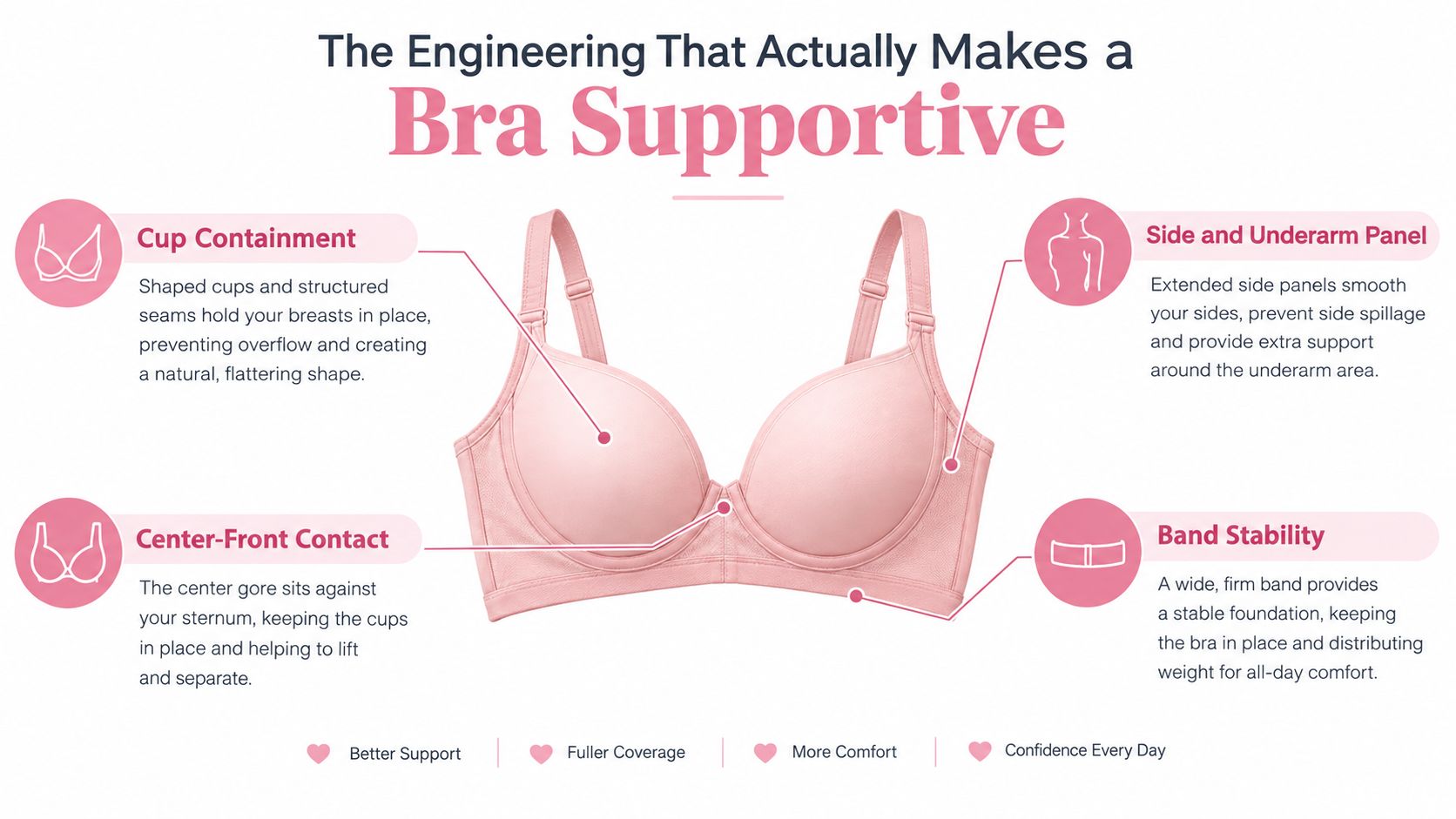
- The Engineering That Actually Makes a Bra Supportive
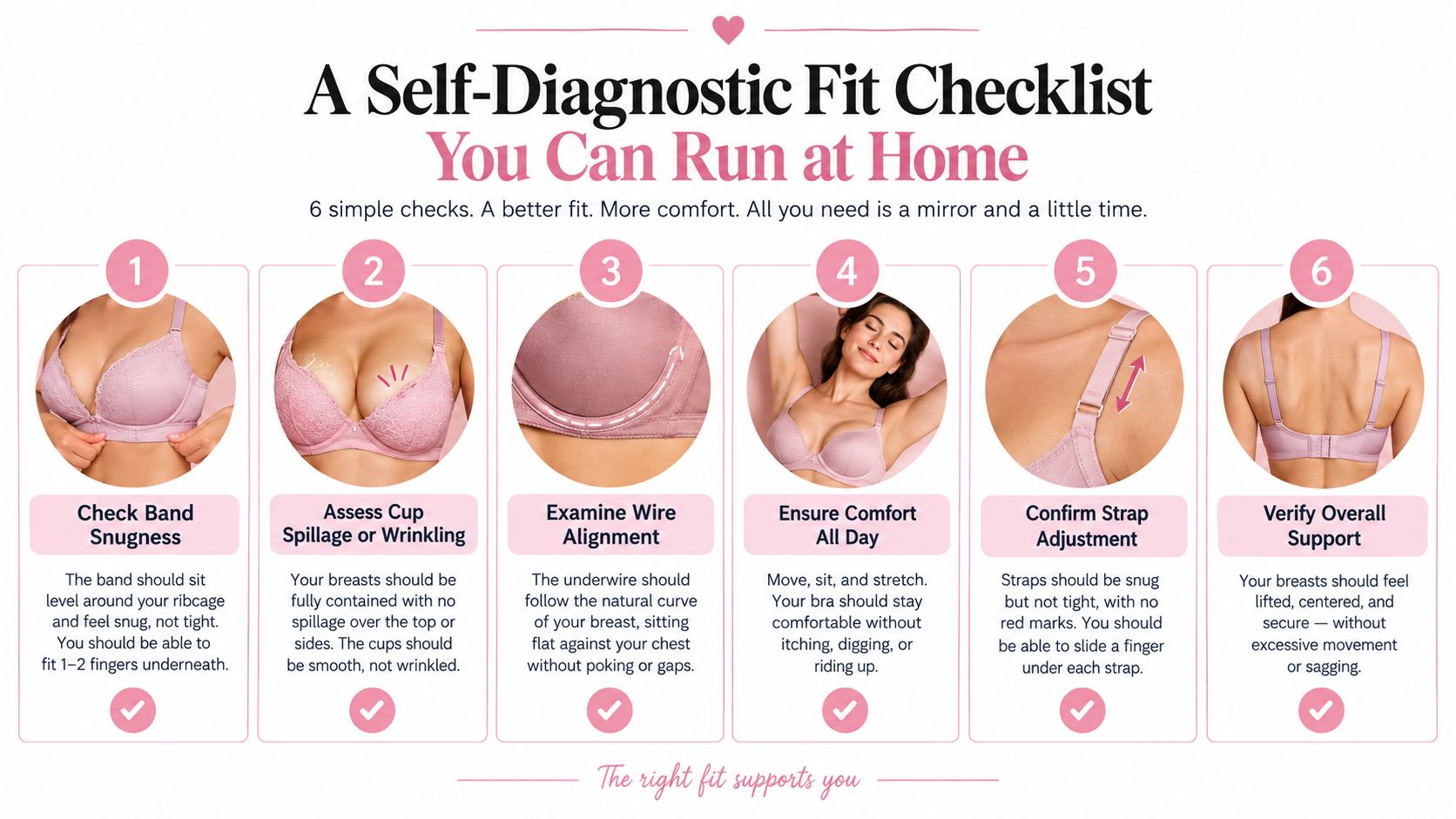
- A Self-Diagnostic Fit Checklist You Can Run at Home
- Underwire, Wireless, and Side Support Compared
- Pairing Full Coverage Bras With Everyday Outfits
- Putting It Together Your Next Five Minute Decision
- FAQ Fit, Coverage, and Support Questions
What Most People Get Wrong About Full Coverage
A shopper often reaches for full coverage after a familiar experience. The bra looks fine while standing still, but the cup edge cuts across the breast when she bends forward. The straps leave marks by lunchtime. The band rides upward when she reaches for a shelf. A higher neckline might hide more tissue, but it hasn't solved the actual problem.
That's because coverage is a containment decision, not a modesty test. A taller cup can help keep more breast tissue inside the cup, while a broader side panel can reduce movement toward the underarm. But those features work only when the cup volume, band tension, and shape match the wearer's body.
A bra can be visibly substantial and still feel unstable. Conversely, a bra with less fabric can feel secure if its cups, band, and straps work together. Research on bra fit supports this distinction. In a 2022 pre-clinical study, all 24 participants failed the fit assessment in their usual bras, and 16 of the 24, or 67%, still failed after professional fitting. The study observed participants during standing, drop-jump, and seated-typing tasks, reinforcing that fit needs to hold up during movement and posture, not only in front of a mirror. The University of Lancashire study explains the fit and movement findings.
Fitting-room rule: More fabric can improve containment, but it can't rescue a loose band, an incorrectly shaped cup, or a misplaced wire.
A useful full-coverage guide therefore needs to answer practical questions:
- What does full coverage cover?
- Which construction details create support?
- How can you diagnose fit at home?
- When should you choose underwire, wireless, or side support?
- Which features make sense under knits, shirts, dresses, and travel clothes?
By the end, you should be able to look at a bra and assess its function instead of trusting the label alone.
Defining Full Coverage Bras and How They Differ
A full-coverage bra generally uses a taller cup that contains most of the breast tissue, a higher center front, and more material along the side and underarm. Its neckline is usually more inclusive than a demi or plunge style, and its side panels often extend farther across the torso.
That shape can help reduce upper-bust spillage and provide a smoother transition beneath higher necklines. It can also create trade-offs. A taller cup may show beneath a low-cut top, and a broad side panel may feel restrictive if the pattern doesn't follow the wearer's breast shape and torso.
Look at four areas when identifying coverage:
- Cup height: A full-coverage cup rises farther over the breast than a demi cup.
- Top-line shape: The upper edge usually follows a higher, more enclosing line.
- Center front: The bridge often sits higher between the breasts.
- Side coverage: The cup or side panel generally reaches farther toward the underarm.
Coverage styles at a glance
| Coverage Style | Cup Height | Neckline Shape | Side Coverage | Best Paired With |
|---|---|---|---|---|
| Full coverage | Tall, containing most breast tissue | Higher and more inclusive | Broad, often extending toward the underarm | Crew necks, button-downs, everyday layers |
| Demi | Lower than full coverage | More open across the upper breast | Moderate | Lower necklines and open shirts |
| Balconette | Mid-height with a more horizontal top line | Open and lifted | Moderate, depending on the pattern | Square necks and structured tops |
| Plunge | Low at the center front | Deep V shape | Often narrower at the center, with varying side coverage | V-neck dresses and tops |
These categories describe a starting shape, not a guaranteed result. A full-coverage bra may still gap at the top if the cup is too large or the upper edge doesn't match the breast. It may still spill if the cup is too small. A plunge may provide enough support for one wearer, while a full cup may feel wrong if its center front presses or its side panel cuts in.
The most useful habit is to inspect the bra rather than relying on its name. Check whether the cup contains the tissue without wrinkling, whether the center front sits where it should, and whether the side fabric lies smoothly against the torso.
Full coverage is a coverage profile. Support is a fit outcome. Treating those as separate questions prevents a great deal of guesswork.
The Engineering That Actually Makes a Bra Supportive
Coverage becomes useful when four functional zones cooperate. Think of the bra as a small support system rather than a single piece of fabric.
Cup containment
The cup should hold the breast tissue without cutting across the top or leaving empty folds. Its depth and shape need to match the wearer, not just the printed size. A tall cup can reduce visible spillage, but if the cup is too shallow, it may compress the breast instead of containing it.
Side and underarm support
A wider side panel can help guide tissue forward and create a smoother line beneath clothing. It needs to lie flat against the torso, though. If it rolls, gaps, or cuts into the underarm, its extra width becomes a discomfort feature rather than a support feature.
Center-front contact
The center front, or gore on many underwire styles, helps establish separation and stability. If it floats away when the bra is meant to sit against the sternum, the cup shape, size, or wire placement may be wrong. Wireless designs use other structural methods, but the same principle applies: the bra must stay anchored between the breasts rather than shifting with every movement.
Band stability
The band carries much of the bra's stabilising work. If it rides up, the straps may take over and begin digging into the shoulders. A full-coverage cup attached to an unstable band can still allow movement, because the foundation underneath it is moving too.
Research involving 309 women wearing encapsulation-style bras found incorrect fit most often in the cups, front band, and straps. Fit problems in the front band, underwire, and straps also varied between breast-size groups, which shows why a single pattern solution can't serve every body equally. The published fit study details the affected bra zones and breast-size differences.
For a closer look at support considerations for fuller busts, Nuage Wears also discusses bras for large breasts. The practical takeaway is simple: cup coverage, side containment, center stability, and band tension must work together. A bra that succeeds in only one zone will feel inconsistent as soon as your posture changes.
A Self-Diagnostic Fit Checklist You Can Run at Home
You don't need to become a fitter to develop a useful vocabulary for bra fit. Stand in front of a mirror wearing the bra on its loosest hook, let your shoulders relax, and check the garment both still and in motion.
Six checks that reveal the common problems
- Check the band. It should sit level around your torso and feel firm without restricting breathing. If the back climbs upward, the band may be too loose or stretched. If it feels painfully tight, try a different size, construction, or band shape rather than loosening the straps to compensate.
- Inspect the cup edge. Breast tissue spilling over the top or sides indicates that the cup may be too small or shaped incorrectly. Wrinkling, folding, or a hollow space can indicate excess volume, a mismatch in cup shape, or a need to adjust the straps.
- Examine the wire or side seam. On an underwire bra, the wire should surround the breast rather than sit on tissue. On a wireless bra, the side seam and support panel should follow the breast root without pressing sharply into it.
- Assess the straps. Straps should help position the cups, not carry the entire weight of the bra. Deep grooves, slipping, or constant adjustment point toward a sizing or construction issue. Change the strap setting only after checking the band.
- Look at the center front. Where the design is intended to meet the sternum, it should stay stable rather than floating, twisting, or digging. A high center front that presses uncomfortably may not suit your breast spacing or torso shape.
- Move before you decide. Sit down, walk, reach forward, lift your arms, and bend slightly. Watch for cup displacement, band movement, underarm pinching, or a sudden loss of containment. A bra that passes a standing check but fails during reaching isn't ready for an all-day wardrobe.
Body measurements can provide a useful starting point when your current size feels unreliable. For a clear, general method, this guide to taking measurements for tailoring can help you measure consistently before comparing a brand's size chart.
Professional fitting can help, but it isn't a guarantee of a correct result. One study reported that 90% of participants failed the fit assessment even in professionally fitted bras, while a later study found that 87.5% still failed a standard bra-fit assessment, compared with 4.2% wearing an alternative support design. The later design also produced clinically meaningful reductions in back discomfort, pain, and stiffness. The peer-reviewed study compares fit outcomes and discomfort measures.
Use the checklist as a conversation starter with a fitter, not as a reason to blame your body. Bodies vary in volume, shape, spacing, and posture. The right bra should respond to those differences.
Underwire, Wireless, and Side Support Compared
The construction you choose changes how full coverage behaves during the day. Underwire, wireless, and side-support designs can all provide containment, but they distribute pressure and create shape in different ways.
| Construction | Support character | Shape and separation | Comfort profile | Outfit compatibility |
|---|---|---|---|---|
| Underwire encapsulation | Defined support around each breast | Usually the clearest lift and separation | Can feel precise when fitted, uncomfortable when misplaced | Structured shirts, dresses, and polished looks |
| Wireless | Softer, more flexible containment | Often less separated and more natural | Useful for lounging, knits, and long wear | Casual layers and relaxed silhouettes |
| Side-support paneling | Directs tissue inward and smooths the outer line | Can improve forward shape without relying only on wire | Depends heavily on panel softness and placement | Close-fitting tops and everyday clothing |
Underwire encapsulation
An underwire cup supports each breast separately, which can create a defined shape and reduce side-to-side movement. It tends to work well when you want a lifted outline beneath a button-down or fitted dress. The wire must follow the breast root, though. If it sits on tissue, ends too far back, or presses at the center, fuller coverage won't make the fit comfortable.
Wireless support
Wireless bras use fabric structure, seams, molded shaping, internal slings, or a stable lower section instead of a wire. They generally trade some separation for softness and flexibility. That can make them practical beneath sweaters, relaxed tops, and clothes worn for extended periods. You can explore the construction differences in Nuage Wears' guide to the best wireless bra.
Side-support construction
Side-support panels wrap across the outer breast and underarm area, helping guide tissue forward while smoothing the silhouette. They're especially useful when the recurring problem is side movement or a visible edge beneath a close-fitting top. The panel still needs the right width and elasticity. Too firm, and it can pinch. Too loose, and it contributes little.
Choose the construction that suits the busiest hour of your day, not the feature that sounds most impressive on the product page.
Nuage Wears' comfort-first range provides one example of how everyday bra design can sit alongside broader comfort, fit, and care guidance. The brand's Journal and customer support resources also include a Best Pair Guarantee for fit-related questions. For any brand, though, judge the actual bra by the movement check, the band, and the way its support zones feel after several hours.
Pairing Full Coverage Bras With Everyday Outfits
A full-coverage bra earns its place when it solves a clothing problem. Start with the outfit that tends to expose discomfort, lines, slipping, or overheating, then select the construction that addresses that issue.
Desk-to-dinner clothing
Under a button-down or work shirt, look for a smooth cup edge and a stable center front. A higher cup can reduce the chance of visible upper-bust spillage when you lean over a desk. A side panel that lies flat can also create a cleaner line beneath a fitted shirt.
Knits and sweaters
Sweaters reveal texture and pressure points. A smooth molded cup or carefully finished seam can reduce visible outlines, while a wireless design may feel less intrusive during long sitting periods. If the knit is close to the body, make sure the side panel doesn't create a raised ridge beneath the fabric.
Fitted dresses
A fitted dress rewards stability. Look for a band that stays level, straps that don't slide, and, where appropriate, bonded support areas that remain in place without creating a hard edge. The higher center front associated with some full-coverage designs can provide structure, but it may not suit a deep neckline, so check the neckline and bra together before committing.
Travel and movement-heavy days
Long days call for breathable materials, gentle pressure distribution, and a design that doesn't require constant adjustment. Mesh zoning can help with airflow, while a stable band reduces the need to pull the bra back into position after walking or reaching. If a bra begins digging or overheating before the outfit does, it won't become more comfortable just because the day continues.
For clothes that are sheer, lightweight, or closely fitted, assess the entire outline rather than only the cups. The aim is to avoid visible lines, slipping, digging, and heat without choosing more coverage than the neckline allows.
Putting It Together Your Next Five Minute Decision
In the fitting room, ask five quick questions:
- Which outfit is hardest today? A fitted knit, a shirt, a dress, or a day involving lots of movement?
- Which construction matches it? Choose underwire for defined separation, wireless for flexible softness, or side support for outer containment.
- Do the fit checks pass? Check the band, cups, side position, straps, center front, and movement.
- What recurring problem should this bra solve? Look for the feature that addresses slipping, lines, digging, or overheating.
- Would you still want to wear it after several hours? Comfort is part of performance, not an optional extra.
Online shopping adds another layer because a product image can't show how the bra behaves on your body. Digital tools such as a virtual try-on platform for retailers may help shoppers visualise fit and styling, but you should still use the same physical checks when the garment arrives.
Shopping supports such as shipping policies, multi-pack bundles, loyalty rewards, and fit guarantees can make it easier to test an everyday bra rotation. They don't replace checking whether the band stays level and the cups stay contained.
FAQ Fit, Coverage, and Support Questions
Does full coverage automatically mean better support? No. Coverage is a starting condition. Support still depends on cup geometry, band stability, side panels, straps, and the way the bra behaves in motion.
How do I know my full-coverage bra fits? Run the six checks above while standing, sitting, walking, and reaching.
Are full-coverage bras only for larger busts? No. Anyone who wants more containment, smoother side coverage, or a higher neckline may prefer them, including smaller-busted wearers under crew necks and knits.
Coverage myths and fit facts
| Common Belief | What the Evidence Says |
|---|---|
| More fabric always means more support | Fabric helps only when the cups, band, and panels fit correctly. |
| A professional fitting guarantees the right result | Fit can still fail after professional fitting, so movement checks remain useful. |
| Full coverage is only about modesty | It can also address containment, side movement, and outfit stability. |
| Standing still is enough to judge a bra | Sitting, walking, reaching, and bending reveal problems a mirror may miss. |
Nuage Wears offers comfort-focused bras and everyday intimates designed around practical fit and wear concerns, including full-coverage styles and customer support resources. Visit Nuage Wears to explore the available options, then use the fit checklist to choose the construction that suits your body and your day.


