


You're standing in front of your closet, holding one pair of pants that looks polished but feels stiff, and another that feels wonderfully soft but loses its shape by midday. You want something breathable for a busy morning, comfortable enough for travel, and aligned with your interest in more responsible clothing. That's why the search for organic cotton pants for women often starts with a simple question, “Will these feel good all day?”
The more useful question is broader. What kind of cotton was used, how was the fabric built, can the organic claim be verified, and will the pants keep their shape after regular care? Organic cotton can be a thoughtful wardrobe choice, but the label alone doesn't determine softness, drape, opacity, or durability.
Table of Contents
- Introduction Why Organic Cotton Pants Belong in Your Wardrobe
- What Makes Organic Cotton Different and How It Feels
- Sustainability Benefits Without the Hype
- How Organic Cotton Pants Feel Wear and Last
- Certifications and Labels Worth Trusting
- Styling Caring and Making Them Last With Everyday Comfort
- Your Confident Choice in Organic Cotton Pants
Introduction Why Organic Cotton Pants Belong in Your Wardrobe
A pair of women's organic cotton pants can follow the rhythm of a full day. A soft knit may suit a work-from-home morning, while a firmer woven pair gives meetings a cleaner shape. The same natural fiber can also work for a weekend trip, depending on how the cloth is knitted, woven, finished, and sewn.
Organic cotton now sits beyond a small eco-label niche. In the 2023/24 harvest year, about 706 thousand tonnes of cotton were estimated to have been certified to one or more farm-level organic standards, representing 2.9% of global cotton production. The previous harvest year reached about 772 thousand tonnes and 3.2% of global output, according to the Organic Trade Association's organic cotton fact sheet. These figures describe certified supply, not a promise that every organic cotton garment feels or performs the same way.
The useful question is how the material becomes pants. A fiber is like flour, while fabric construction is the recipe. Knit structure can create flexible, lounge-ready comfort; woven construction can provide a crisper hand and steadier shape. Weight, stretch, finishing, seams, and waistband design then determine how the garment behaves on the body.
Certification adds another layer. It helps verify whether the organic claim is supported through the relevant parts of the supply chain, while the garment's construction explains its feel and fit.
Before buying, check fabric weight, opacity, recovery, seam quality, waistband structure, and care instructions. Read the label as a guide, then use your hands and eyes to judge the cloth. That approach makes organic cotton pants easier to understand and choose with confidence.
What Makes Organic Cotton Different and How It Feels
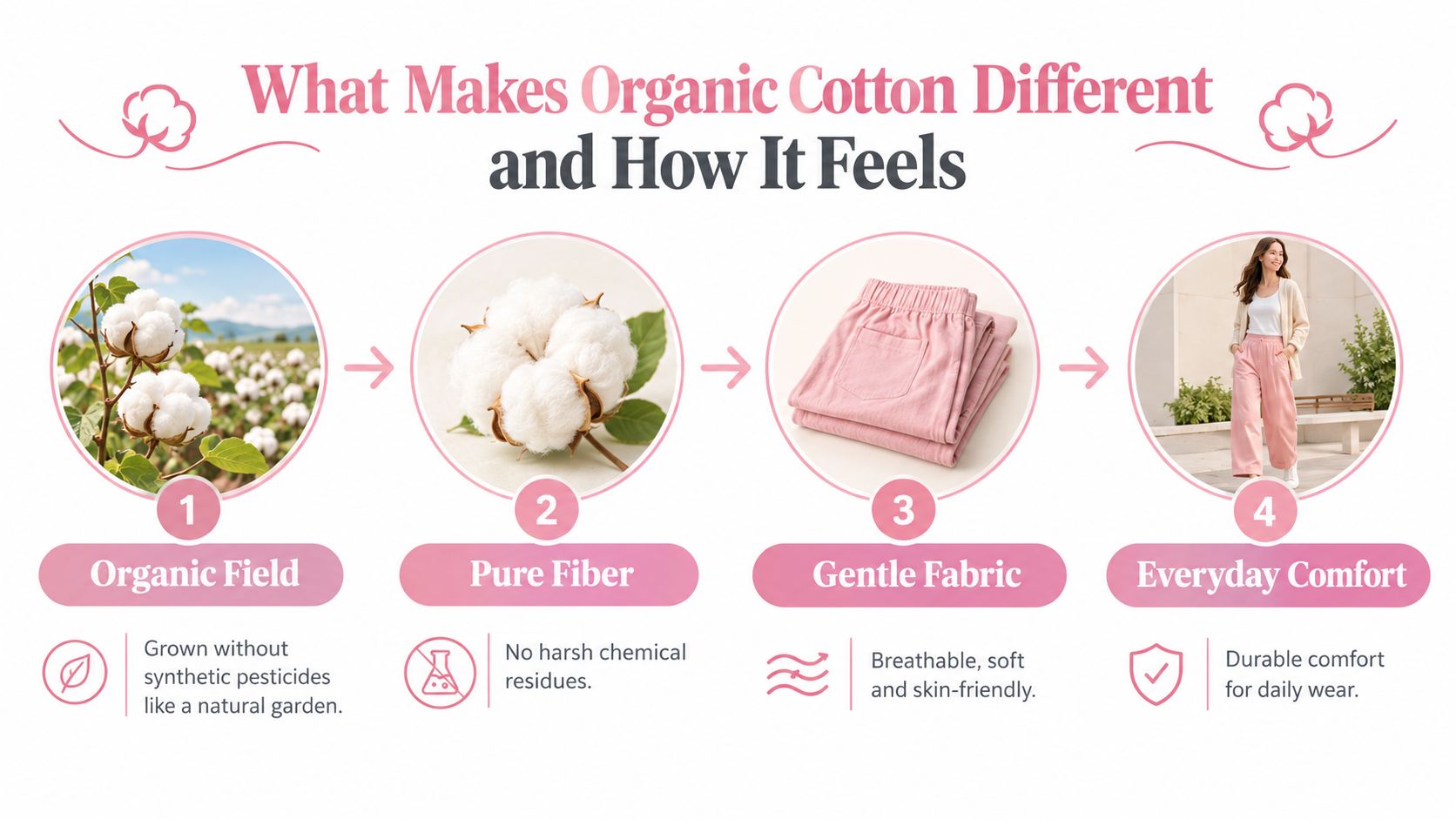
A pair of organic cotton pants can feel cool and airy in one shop, then firm and structured in another. The word organic describes how the cotton was grown. The fabric's touch comes from what happens afterward, especially the yarn, knit or weave, weight, stretch, and finishing.
Organic farming works like tending a garden without synthetic shortcuts. Farmers use practices such as crop rotation and other approved methods instead of relying on synthetic pesticides and fertilizers. That choice changes the farming system and supply chain, while the resulting cotton remains the familiar natural fiber.
After harvest, cotton is cleaned, spun into yarn, and formed into fabric. It may feel absorbent, smooth, crisp, brushed, or substantial, depending on how textile makers prepare and construct it.
Fiber is only the beginning
Textile Exchange explains that organic cotton has no differences in use, handfeel, or processing compared with conventional cotton. Organic-cotton staple length commonly ranges from 20 to 45 millimetres, supporting yarn counts from Ne 10 to Ne 90, as described in its organic cotton fiber classification guide.
The terms become easier with a tactile comparison. Staple length is the length of each cotton fiber, like the length of individual hairs in a brush. Longer fibers can help spinners make smoother, more consistent yarns. Yarn count describes yarn fineness. Fine yarn can produce a lighter, smoother surface, while thicker yarn can create a more textured or sturdy cloth.
So, the organic label is a farming clue, not a texture forecast. It does not tell you whether the pants use soft jersey, dense twill, loose gauze, or firm denim-like fabric.
Fabric construction creates the sensation
Knit structure controls much of the stretch and recovery. A soft jersey can move easily over the hips, while a compact knit may feel more supportive. Woven cotton pants usually hold a steadier shape, with the weave influencing crispness, strength, and drape.
Finishing changes the surface too. Brushing raises a fuzzy, warmer nap. Compacting can help limit dimensional change. Dyeing and other finishing treatments also affect handfeel, so cotton from the same agricultural source can become very different garments.
A useful shopping rule: treat “organic” as a sourcing clue, then judge comfort through the yarn, structure, weight, stretch, and finish.
Use your hands as a simple fabric test. Pinch the cloth, then release it. Notice whether it springs back, folds softly, or keeps its shape. Rub the surface lightly between your fingers. Smoothness, dry crispness, and brushed softness are all possible, and none belongs automatically to organic cotton.
Sustainability Benefits Without the Hype
Organic cotton identifies a farming method, not the environmental record of an entire pair of pants. Certified organic farming avoids synthetic agricultural inputs covered by the relevant standard. The finished garment still reflects spinning, dyeing, cutting, sewing, transportation, and care.
That boundary keeps the label useful. It gives you evidence about the fiber's agricultural origin, while the pants' construction and supply chain require separate questions.
What changes on the farm
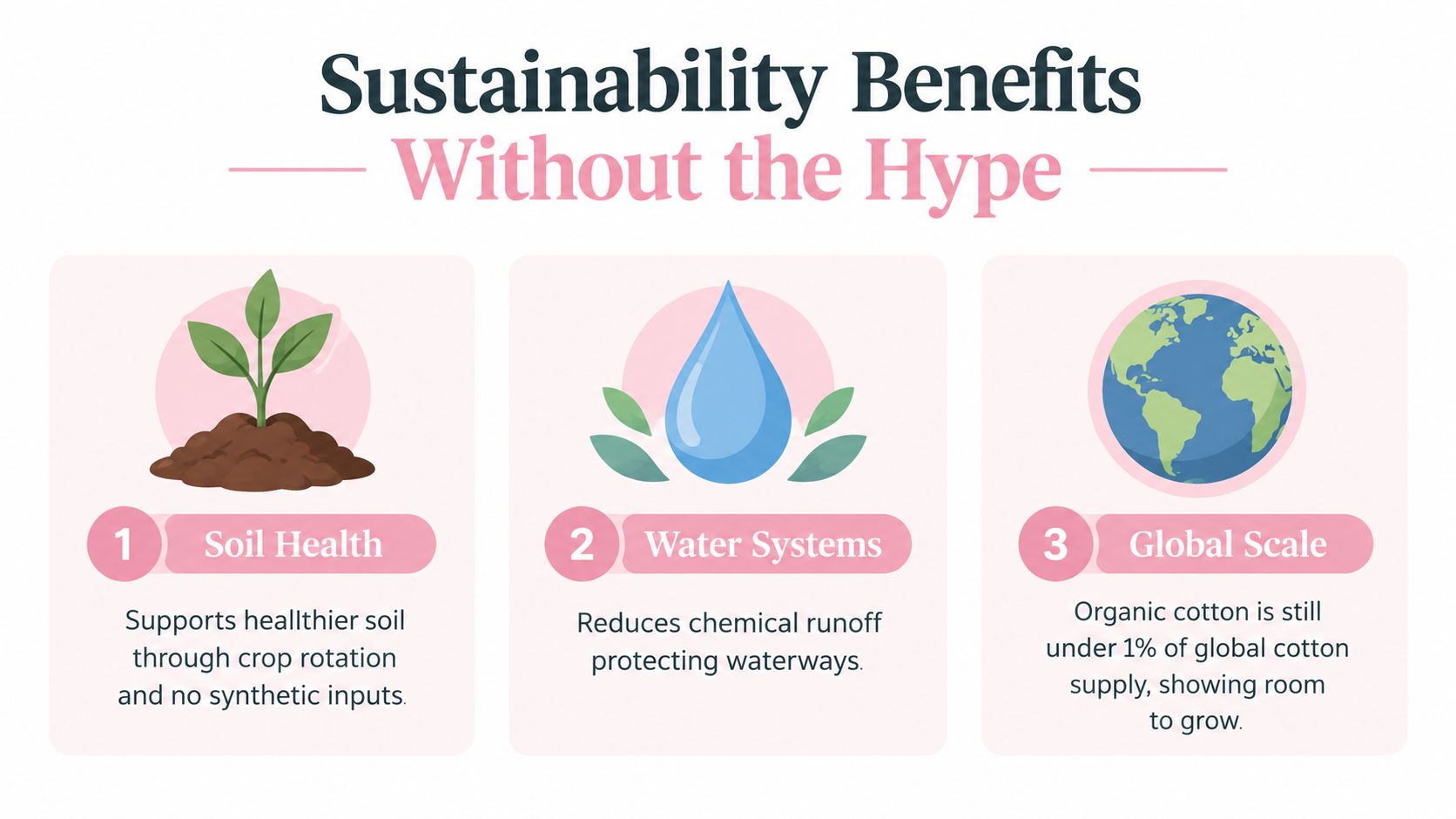
Organic systems may support soil management through crop rotation and other natural soil-building methods. Avoiding synthetic pesticide and fertilizer inputs can also reduce the risk of chemical runoff reaching nearby waterways. Results depend on how each farm manages land, water, pests, and surrounding ecosystems. A certification therefore signals a defined standard, not a promise that every impact disappears.
Supply is growing, though certified organic cotton remains one part of the wider cotton system. United States production of organic Upland and American Pima cotton reached 56,717 bales in 2024, which was 17,458 bales more than in 2023. The change shows how acreage and demand can alter availability within a relatively short period.
Why pants pricing can move
Women's pants are part of the apparel demand that uses organic cotton fiber. One independent organic cotton market estimate valued the market at about USD 1.8 billion in 2025 and projected roughly USD 3.6 billion by 2034, with a projected 8.1% CAGR. The same source also estimated a market near USD 2.26 billion in 2026, forecasting it above USD 9.7 billion by 2035.
Those figures are independent estimates rather than one official measurement, so they should not be combined as if they describe the same model. They do share a broad direction: apparel is the dominant use case, with reported shares ranging from 48.3% to about 60%.
For shoppers, the connection is practical. Pricing and availability can reflect farm conversion, certified fiber supply, yarn production, and textile orders, alongside seasonal fashion decisions.
A realistic wardrobe perspective
A pair of organic cotton pants becomes a more considered purchase when its cut, knit or woven structure, and certification fit your needs. The farming benefit matters most when the garment is worn regularly, washed appropriately, and kept in rotation rather than treated as a rarely worn symbol.
How Organic Cotton Pants Feel Wear and Last
You try on a pair of organic cotton pants for a slow morning, then sit, walk, and bend through the rest of the day. Their comfort comes from more than the organic label. Fiber origin describes how the cotton was grown, while fabric construction determines how the pants move, hold their shape, and respond to washing.
A lightweight jersey feels cool and flexible, much like a soft T-shirt. Dense woven cotton feels smoother and more structured. A brushed inner surface adds warmth, while a compact fabric gives a cleaner outline under a longer top. For relaxed styles, women's cotton lounge pants show why knit structure and pattern shape matter as much as fiber choice.
Compare the details, not just the label
| Feature | What Organic Label Means | What Construction Decides |
|---|---|---|
| Softness | Identifies the agricultural origin of the cotton | Yarn fineness, surface treatment, and finishing |
| Stretch | Doesn't guarantee flexibility | Knit structure and any elastane blend |
| Drape | Doesn't predict how pants hang | Fabric weight, weave, knit density, and cut |
| Opacity | Doesn't ensure coverage | Thickness, color, density, and layering |
| Durability | Doesn't automatically promise longer wear | Yarn strength, fabric density, seam quality, and laundering |
The waistband also shapes daily comfort. A wide, softly finished band spreads pressure across the body, while narrow elastic may pinch even when the fabric feels pleasant. Examine the crotch construction and inseam seams. Uneven stitching, loose threads, or abrupt seam changes can rub during walking and sitting.
A simple rule helps: construction predicts performance more directly than the organic label. Organic origin still matters, but it cannot replace fabric testing, sound seams, or a well-shaped pattern.
A simple try-on test
Bend your knees, sit, and take a few steps. Notice whether the waistband rolls, the knees pull sharply, or the fabric turns transparent under tension. For online shopping, inspect close-up images for weave density, seam finishing, pocket placement, and the care label.
A small amount of elastane can improve stretch recovery and ease, but it changes the fiber composition. Read the complete material breakdown rather than assuming organic cotton means the pants contain cotton alone. The right choice joins a verified fiber claim with a knit or woven structure suited to how you move and care for the garment.
Certifications and Labels Worth Trusting
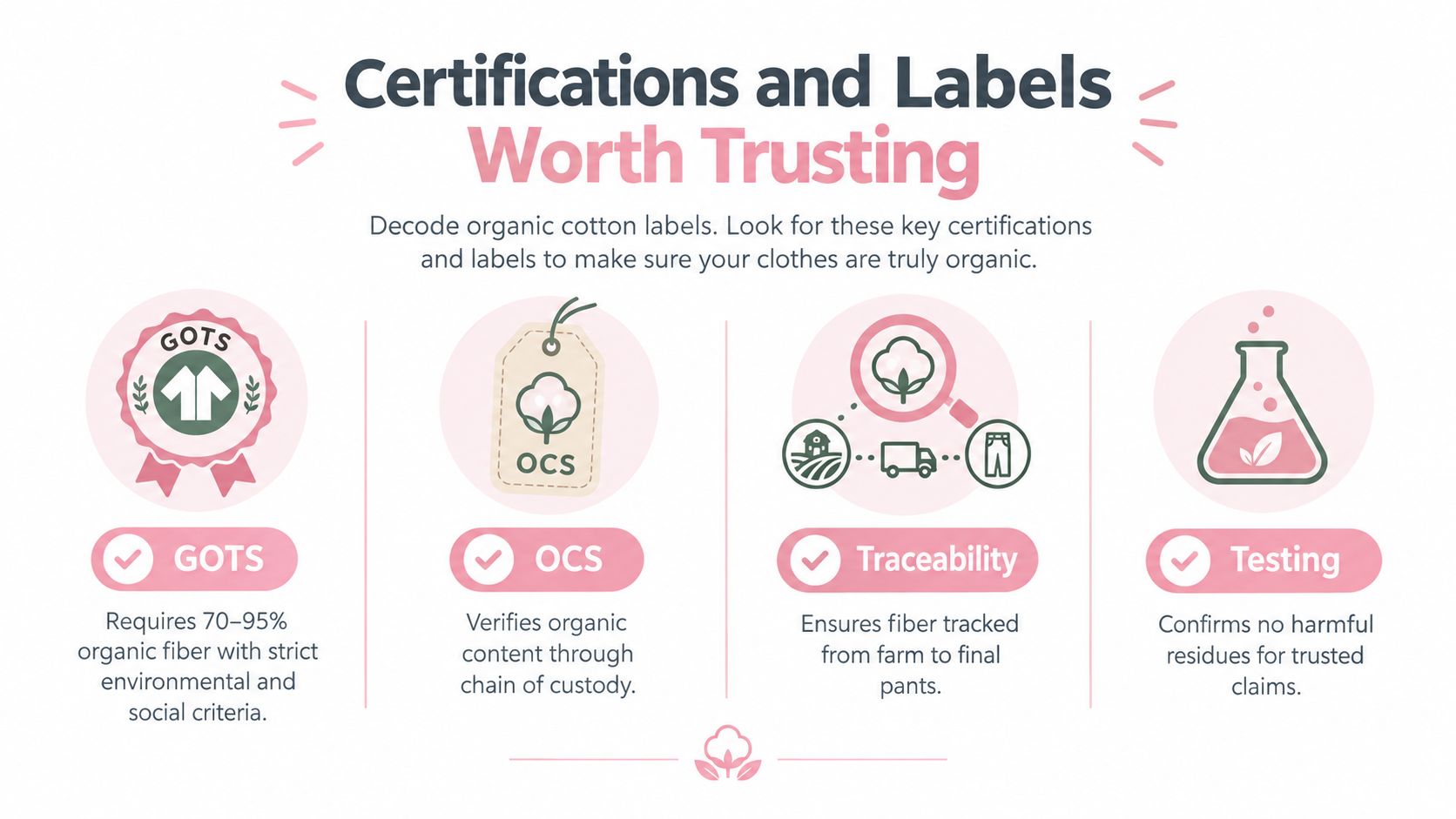
A trustworthy organic cotton claim should give you something to verify. Look for the certification name, the scope of the claim, the fiber composition, and information about the product's supply chain. A vague phrase such as “made with organic materials” tells you less than a certification that identifies content and traceability requirements.
Read the percentage carefully
OEKO-TEX® ORGANIC COTTON requires at least 70% organic cotton content, prohibits blending conventional and organic cotton through that certification route, and adds supply-chain traceability along with tests for GMO contamination and pesticides, according to the OEKO-TEX® ORGANIC COTTON factsheet. Hohenstein's certification summary indicates GMO testing thresholds below 5% and negative pesticide-test expectations.
The percentage matters because fiber content and certification coverage aren't the same thing. A garment might contain an organic cotton majority but include other fibers, trims, or components that fall outside the claim. Check whether the certification applies to the pants, the fabric, or only a particular production stage.
Use a checkout checklist
A clear label doesn't need to overwhelm you. Ask these questions:
- What is the exact fiber composition? Find the percentage of organic cotton and identify elastane, recycled fibers, or other blends.
- Which certification applies? Look for a named standard rather than a broad sustainability phrase.
- Does the claim include traceability? A chain-of-custody approach helps connect the cotton source to the finished fabric.
- Are testing requirements visible? GMO and pesticide testing can provide useful reassurance for clothing worn close to the skin.
- Can the brand explain the garment? Product pages should make the fabric, construction, and care instructions understandable.
Don't treat every certification as identical. Some focus primarily on organic fiber content, while others combine fiber requirements with processing, environmental, or social criteria. Your job isn't to memorize every standard. It's to match the label to the question you care about.
At checkout: if the product page names the fiber, certification, and care method clearly, you have a stronger basis for comparison than a vague eco claim.
Avoid relying on competitor links to verify a purchase. Editorial guidance warns that direct competitor links can send readers away or conflict with publishing policies, and recommends original research or unlinked brand mentions when comparison isn't necessary, as explained in this content linking guidance. For your own shopping, use the certification information printed on the product page or garment label and ask the brand for documentation when the wording remains unclear.
Styling Caring and Making Them Last With Everyday Comfort
Organic cotton pants can move through several parts of your day if you style them around their structure. A soft straight-leg knit works with a crisp shirt or a short jacket. Wide-leg woven pants benefit from a closer-fitting tank or tee, which balances volume without making the outfit feel fussy.
For work, try a structured top, clean shoes, and a waistband that lies flat beneath a tucked shirt. For travel, choose a forgiving knit or a drawstring style with secure pockets, then add a lightweight layer for changing temperatures. Off duty, a simple tee, cardigan, and comfortable flats can make the pants feel intentional rather than like sleepwear.
A breathable base layer can make fitted pants more comfortable. Nuage Wears' NuSoft Modal Brief 5-Pack and NuSoft Classic Cotton Brief are examples of underwear options designed to sit smoothly beneath everyday clothing, with the latter using a cotton gusset and a stay-put mid-rise fit. Keep the foundation simple so the pants remain the focus.
For more ideas on lightweight layering, see this guide to an organic cotton tank.
Care that protects the fabric
Follow the garment's own care label first, especially when the pants contain elastane or have a special finish. In general, a cool or cold wash can be gentler on cotton fibers and color than a hot cycle. Air drying can also reduce heat exposure and help limit unnecessary shrinkage.
Try this care rhythm:
- Wash thoughtfully: Turn pants inside out and use a gentle cycle when the label permits.
- Skip excess heat: Remove them promptly and reshape the waistband, seams, and legs while damp.
- Air dry when possible: Hang structured woven pants or lay stretch knits flat if hanging could distort them.
- Treat marks early: Spot-clean a small stain rather than washing the entire garment repeatedly.
- Store with room: Fold heavier knits and avoid overcrowding delicate fabrics.
The blog cover image for this article is displayed at 280 by 210 pixels, a 4:3 aspect ratio, because both dimensions reduce to that width-to-height relationship, as explained by this aspect ratio calculator. Publishing dimensions don't affect fabric performance, but they do matter when you're preparing clear, useful product and editorial visuals.
Your Confident Choice in Organic Cotton Pants
You are standing in a fitting room, one hand testing the waistband and the other checking the label. A confident choice comes from examining the pants as fabric construction, not treating “organic” as the whole answer. Ask three questions: does the material suit your movement, can the fiber claim be verified, and will your care routine protect the garment?
Begin with touch and motion. Pinch the fabric, sit down, bend, and see how the waistband responds. A knit behaves like a flexible mesh, while a woven fabric holds a firmer grid. That structure helps explain why organic cotton may feel soft, crisp, dense, airy, or structured. Fiber content and construction belong together.
Read the label carefully. Look for a named certification, clear fiber composition, and care instructions. Certification connects the organic claim with defined requirements, while traceability and testing make the information easier to assess. These details matter when the pants rest against your skin for much of the day.
Then choose a silhouette you will wear. A pair that works with tanks, shirts, sweaters, and practical base layers is more likely to leave the closet regularly. Frequent wear gives the purchase lasting value.
Use this quick check while shopping: feel the fabric, inspect the knit or weave, verify the claim, and follow the care label. No textile engineering degree is needed. Careful observation is enough.
Nuage Wears offers comfort-first underwear and everyday apparel, including breathable cotton and soft foundation layers suited to organic cotton pants. Visit Nuage Wears to explore pieces for workdays, travel, and downtime.


