


A size 36F bra typically corresponds to an underbust of roughly 35–36 inches and a full bust of roughly 43–44 inches. The exact fit still depends on the sizing system, your body shape, and the bra's construction, so 36F isn't one universal measurement.
What if the number and letter on a bra tag describe a relationship rather than a fixed body shape? That's the key to understanding size 36F bras. The 36 refers to a band category in inch-based systems, while F describes cup volume relative to that band. Change the country, brand, wire shape, or fabric, and the same label can feel noticeably different.
Bra sizing is also relatively modern. In October 1932, S.H. Camp and Company became the first reported manufacturer to use alphabetic cup labels, although those early letters described breast shape or pendulousness rather than precisely standardized volume. Band numbers became widely established in the 1940s, reinforcing the idea that a bra size combines two related measurements rather than naming one universal physical specification. (Historical overview of bra sizing)
Table of Contents
- How to Understand Your 36F Bra Measurements
- Why 36F Bra Labels Vary Across Brands
- Sister Sizes and Volume Equivalents
- Checking the Fit and Placement
- Troubleshooting Common Fit Problems
- Selecting Features for Support and Comfort
- Navigating Real-World Scenarios
- Using Nuage Wears Fit Resources
How to Understand Your 36F Bra Measurements
Could a 36F label identify the right bra on its own? Measurements give you a better starting point. Take two readings, an underbust around the ribcage and a full bust around the fullest part, then interpret them together rather than treating either figure as a fixed rule.
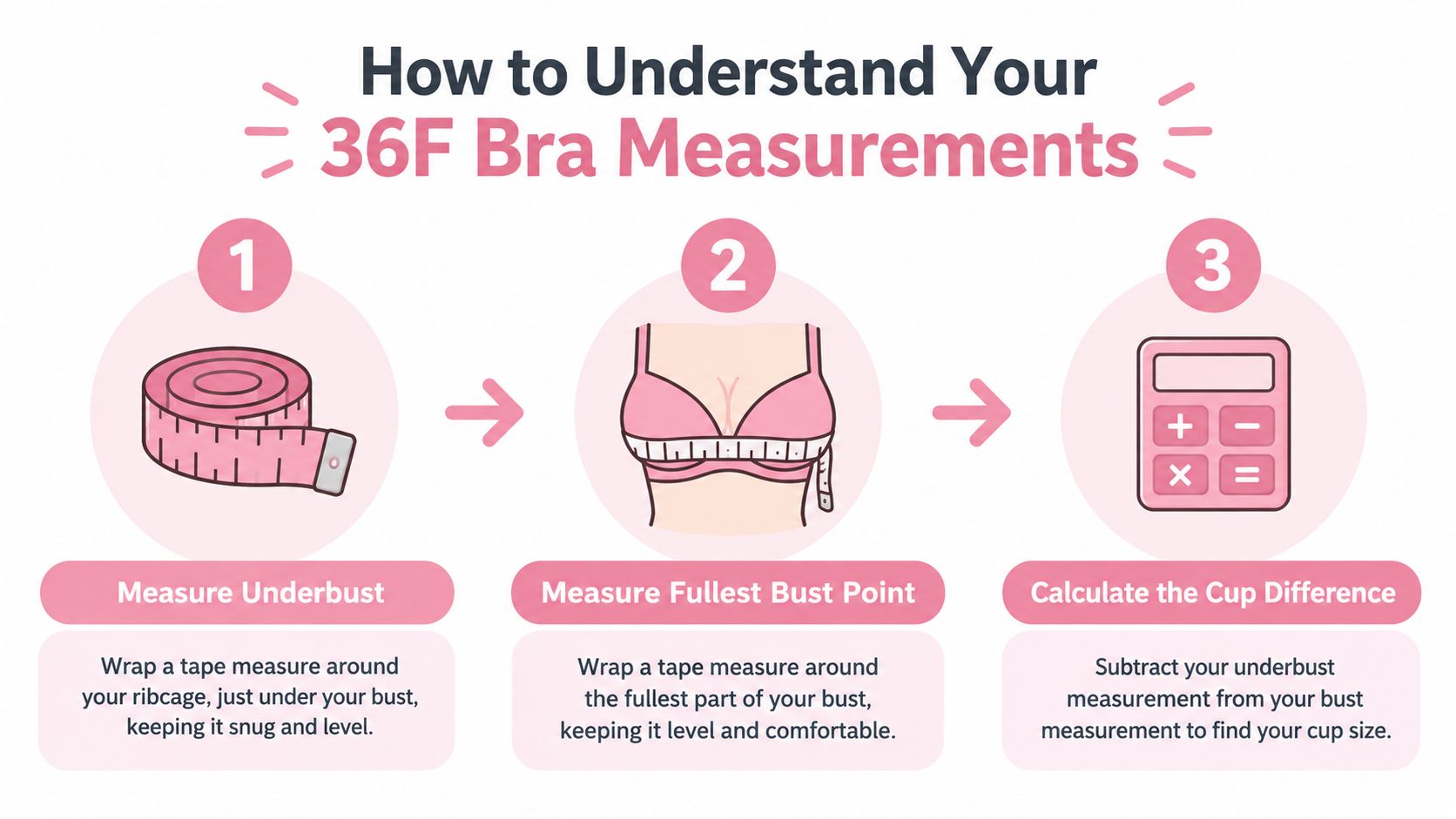
Take the underbust measurement first
Stand naturally and place a soft tape directly beneath the breast tissue. Keep it level from front to back, snug enough to touch the body but not tight enough to compress your ribs or affect breathing. A practical 36F guide places this measurement near 35–36 inches, or 89–91 cm, as a starting range rather than a precise manufacturing specification. (Measurement guidance for 36F sizing)
The underbust helps you judge band tension. A well-fitting band stays level around your body and feels secure without digging in, rolling, or leaving severe pressure marks. Since the band supplies much of the support, a loose or painfully tight band can make the entire bra feel wrong.
Measure the fullest bust
Run the tape around the fullest part of your bust, keeping it parallel to the floor. Let it rest lightly, and don't compress breast tissue. A commonly published 36F range places the full bust near 43–44 inches, or 109–112 cm. Use that figure as a reference, because sizing systems and bra shapes can produce different results.
The gap between the underbust and full bust helps estimate cup volume, much like comparing the outside dimensions of two containers. It cannot show breast shape, projection, or the best wire placement. If your breasts are especially projected or shallow, standing and leaning measurements can add useful context.
Practical rule: Use measurements to choose a starting size, then let the bra's fit signs confirm or reject the label.
Record both figures and check the sizing system before ordering. A product chart should identify UK, US, EU, or another convention and provide underbust and full-bust guidance. That matters because the same 36F label can represent different proportions across systems, brands, and construction methods.
Why 36F Bra Labels Vary Across Brands
A bra label is a sizing language, not a universal physical standard. The number establishes a band category, while the cup letter describes volume in relation to that band. Since brands grade patterns differently, two bras marked 36F can have different wire widths, cup depths, band tension, strap positions, and fabric stretch.
The country of origin adds another layer. In UK sizing, the commonly cited progression after D is DD, E, F, FF, G, and beyond. US labels may use DDD or F and then G, which creates direct-conversion problems. A comparative chart lists a seven-inch bust-to-underbust difference as F in UK and Australian sizing but G in the US and Canadian column. The same chart lists a six-inch difference as E in UK and Australian sizing and F or DDD in the US.
The letter doesn't carry a fixed volume
An F cup on a 36 band isn't the same absolute capacity as an F cup on a 34 band. The cup scales with the band, which is why sister-size logic matters. The number 36 also doesn't guarantee a precisely 36-inch underbust, because rounding, grading methods, and measuring practices differ between manufacturers.
International labels add further confusion. A commonly used conversion lists a UK 36F as approximately EU 80G, French or Spanish 95G, and Australian or New Zealand 14F. Some US charts may use 36G for a comparable volume, while others may use 36F within a different cup progression. (International 36F conversion guidance)
Read the chart as a translation guide
Before ordering, check three details:
- Sizing origin: Confirm whether the product uses UK, US, EU, French, Spanish, or Australian conventions.
- Measurement basis: Look for underbust and full-bust ranges, not just a familiar letter.
- Construction notes: Check whether the bra is molded, stretch-based, wireless, underwired, full coverage, or designed with a particular cup shape.
The safest interpretation is simple: 36F is a label within a system, not a globally identical physical specification.
Sister Sizes and Volume Equivalents
What happens when the cup seems close but the band doesn't? Sister sizes give you nearby options by changing the band and adjusting the cup letter in the opposite direction. Moving to a larger band generally means moving to a smaller cup letter to preserve a similar cup volume. Moving to a smaller band generally means moving to a larger cup letter.
Compare the closest options
| Band Size | Cup Size | Equivalent Volume |
|---|---|---|
| 34 | FF | Similar volume to 36F in many UK-style progressions |
| 36 | F | Starting size |
| 38 | E | Similar volume to 36F in many UK-style progressions |
This table is a volume comparison, not a promise that every bra will fit identically. The wire width, center-gore position, strap spacing, and band tension change as the frame changes. Sister sizes work most predictably when you move only one step.
If the 36 band feels too loose while the cup volume seems right, try the smaller-band sister size with a larger cup letter. If the 36 band feels too tight while the cups seem appropriate, try the larger-band sister size with a smaller cup letter. Don't move to a larger band and keep the F cup automatically, because that usually increases both the band and the cup volume.
For a related explanation of how band and cup relationships work, see this bra size guide. Use the product's own chart as the final reference, especially when switching between sizing systems.
Checking the Fit and Placement
A bra can match your measured starting size and still sit incorrectly. Put it on the loosest hook, lean forward slightly, and guide breast tissue into the cups. Then check the bra from the front, side, and back instead of judging it only by how it looks under clothing.

Inspect the band and center
The band should sit horizontally around your torso. If it rides up at the back, it may be too loose, overly stretchy, or carrying too much of the support because the straps are tightened too far. If it feels sharply restrictive, test the band independently with the cups positioned correctly before changing sizes.
If the style is designed for the cups to meet at the center, the center gore should lie close to the sternum. A floating gore can indicate insufficient cup room, a shape mismatch, or a bra construction that doesn't suit your anatomy.
Confirm the wire and cup coverage
An underwire should encircle the breast root rather than rest on breast tissue. The cup should contain the breast without overflow at the neckline, sides, or underarm, while also avoiding loose fabric or wrinkles.
Use these checks together. A cup that gaps at the top may be too large, but it may also be the wrong shape for a shallower upper bust. A cup that spills may be too small, too narrow, or too shallow. The visible symptom tells you where to investigate, not always which size to choose.
Here's a visual fitting reference you can use while checking band stability, cup placement, and strap position:
Troubleshooting Common Fit Problems
Could the symptom be pointing to a shape or construction issue rather than a simple size error? A 36F bra that gaps, spills, digs, or rides up may need a different cup shape, band adjustment, or design, even when the label appears correct.
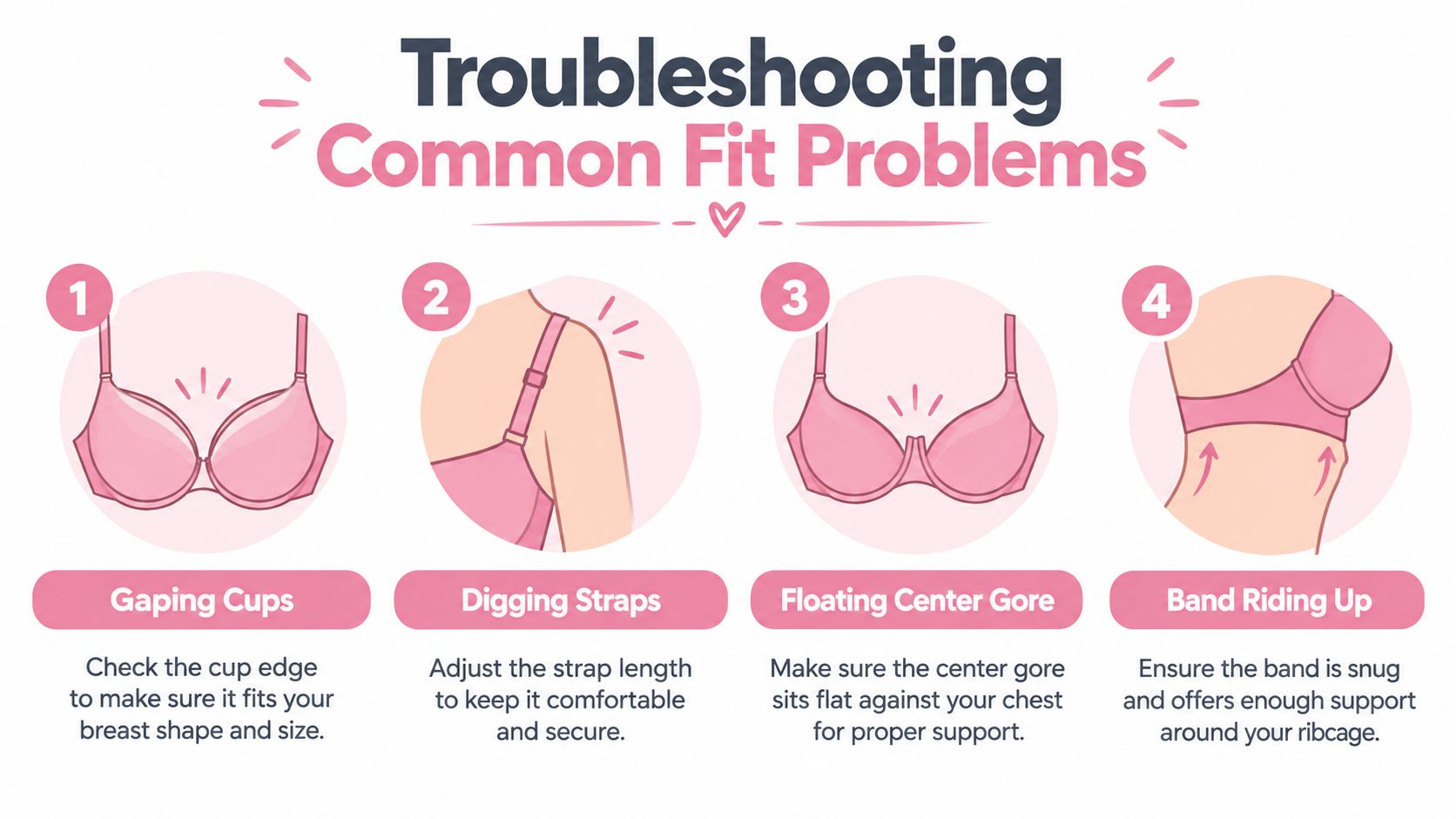
- Gaping cups: Identify where the space appears. A gap at the neckline may reflect a cup that is too large, while space near the strap can indicate a cut that does not match your upper-bust shape. A different style may fit better than just choosing a smaller cup.
- Cup overflow: Spillage at the neckline or sides usually calls for more cup room or fuller coverage. Re-scoop your tissue into the cups and settle the band first, since tissue can shift outside during dressing.
- Digging straps: Loosen the straps slightly and check whether the band is providing most of the support. If pressure remains, try wider or padded straps, or reassess whether the band is too loose and forcing the straps to work harder.
- Floating center gore: The cups may be too small, too shallow, or shaped differently from your breast placement. In wireless styles, a floating center can be intentional, so assess it alongside support, stability, and comfort.
- Band riding up: A rising band often signals insufficient anchoring. Try a firmer band while confirming that the cups still contain your breast tissue. A smaller-band sister size can work when the current cup volume remains suitable.
A bra-fit analysis found objective fit problems among all participants. Cups were too large for 63%, the front band failed to contact the sternum for 58%, and straps were loose for 50%. Personal assessments matched objective evaluations only 51% of the time, so a mirror check may miss problems that affect support. (Bra-fit analysis)
Fit is a system: wire geometry, fabric behavior, breast shape, and band tension work together. A larger cup does not automatically mean greater discomfort, and a smaller label does not guarantee a better fit.
Selecting Features for Support and Comfort
Which features help a 36F bra feel supportive throughout the day? Cup depth matters, yet comfort depends on how the entire design distributes pressure. A deep cup can still feel unstable if the band stretches too much, the straps sit too close together, or the underwire does not follow your breast root.
Prioritize the support network
Adjustable straps let you fine-tune lift while keeping the band responsible for most of the support. They should stay in place without leaving deep grooves. Wider straps can spread pressure over more shoulder area, although width cannot correct a riding band or cups with insufficient room.
A firm, comfortable underband anchors the bra against your torso. Look for a band that lies level and feels supportive on the loosest hook when new, leaving room to tighten it as the elastic ages. In an underwired design, stable wires and separated cups can help limit movement without making the shoulders carry the load.
Encapsulation construction gives each breast its own cup area. This arrangement can provide clearer separation and movement control than a single compression panel. Compression can suit certain activities, but strong compression may create pressure points when the shape or size does not match your body.
Match materials to your day
For extended wear, breathable mesh, smooth seams, and soft edges can reduce heat and friction. Smooth or laser-cut finishes sit discreetly under close-fitting clothing, while structured panels can offer more containment when you want a steadier outline.
Choose features by the problem they solve. For fuller-bust support considerations and useful fit terms, this guide to bras for larger breasts provides another product-selection perspective.
A bra label cannot predict comfort on its own. Fabric stretch, wire shape, seam placement, and breast position all influence how pressure feels, so compare construction details with your measurements and the way you move.
Navigating Real-World Scenarios
A well-fitting 36F bra should work with your routine, not just look correct while you stand still. The right design for a desk day may not be the right design for exercise, travel, or warm weather.

For desk work and long days
Choose a band that stays level without constant adjustment and cups that contain tissue without pressing sharply at the center. Smooth edges and breathable components can make a difference during extended wear, particularly under fitted work clothing.
If your shoulders feel tired, check the band before tightening the straps. Straps should refine the fit, not carry the entire load. A properly placed band can make a supportive bra feel noticeably less intrusive during sitting, walking, and routine movement.
For walking and travel
Walking and travel demand stability without excessive stiffness. Separate cups, secure straps, and a fabric that manages moisture can help when you're moving between temperatures or wearing the bra for many hours. A bra that feels comfortable for a short fitting may reveal rubbing at the underwire or side panel during a full day, so notice pressure points early.
For exercise
Movement changes the decision. A sports bra may use compression, encapsulation, or a combination of both. Choose based on the activity's movement demands, then check that the band stays anchored, the cups don't create overflow, and the straps don't slip when you raise your arms.
A study involving 45 participants found meaningful differences between traditional and professionally determined best-fit sizes, particularly among larger sizes, but it didn't establish that professional fitting improved comfort or support. (Bra fit and best-fit sizing research) That's why personal movement testing matters. Walk, bend, reach, and take a few deeper breaths before deciding that a size or style works.
Using Nuage Wears Fit Resources
Could a calculator improve your 36F starting point without deciding the fit for you? Begin with your snug underbust and relaxed full-bust measurements. Enter both accurately in the Nuage Wears size calculator, select the relevant sizing system if prompted, and compare its recommendation with the product's own chart. A label is a starting address, not a guarantee that every cup shape or band will suit you.
If the result falls between sizes, review the nearest sister size before changing both measurements. Sister sizing changes the band and cup letter together while aiming for a similar cup volume, so compare the actual fit rather than treating the letter as fixed. Product design matters too. Smooth edges may work better under close-fitting clothing, breathable materials can help in warm conditions, and stay-put construction can support movement.
Use the fit policy before ordering
Read the Best Pair Guarantee and return guidance before buying. Online sizing cannot fully account for projection, breast shape, wire geometry, or fabric stretch. Keep tags and packaging intact while testing the bra indoors, then assess the band, center, underwire, straps, and cups as one system.
Nuage Wears groups comfort needs by concerns such as visible lines, rolling, digging, and breathability. These categories can direct you toward a construction that addresses your specific problem instead of relying on the 36F label alone.
For teams and creators presenting product details, building product visuals with AI may help show garment features and fit construction more clearly. Those visuals can support a buying decision, but measurements, product charts, and a clear return process remain the stronger guides.
Nuage Wears offers comfort-focused bras and everyday intimates organized around breathable wear, smooth finishes, and stay-put support. Use your underbust and full-bust measurements, review the relevant fit resources, and visit Nuage Wears to explore options for your own 36F fit.


