


You're halfway through getting dressed when you notice the waistband has folded under your stomach. It leaves a deep mark, rolls when you sit, and somehow still manages to slide down when you stand. You chose a high-rise pair for extra coverage, but the label alone hasn't solved the problem.
High-rise panties work well when their height, fabric, edges, and waistband tension match your body and your clothes. They can cover more of the lower abdomen and sit naturally under high-waisted trousers, but a higher cut doesn't automatically mean greater comfort. The useful question is not whether high rise is right for you. It's which construction stays comfortable while you walk, bend, sit, and move through a full day.
Table of Contents
- Defining the High Rise and Finding Your Measurement
- High Rise Versus Mid Rise and Low Rise Cuts
- Pros and Cons of High Rise Panties
- Outfit Pairings and Real World Use Cases
- How to Choose the Right High Rise Construction
- Building Your Ultimate Comfort First Drawer
Defining the High Rise and Finding Your Measurement
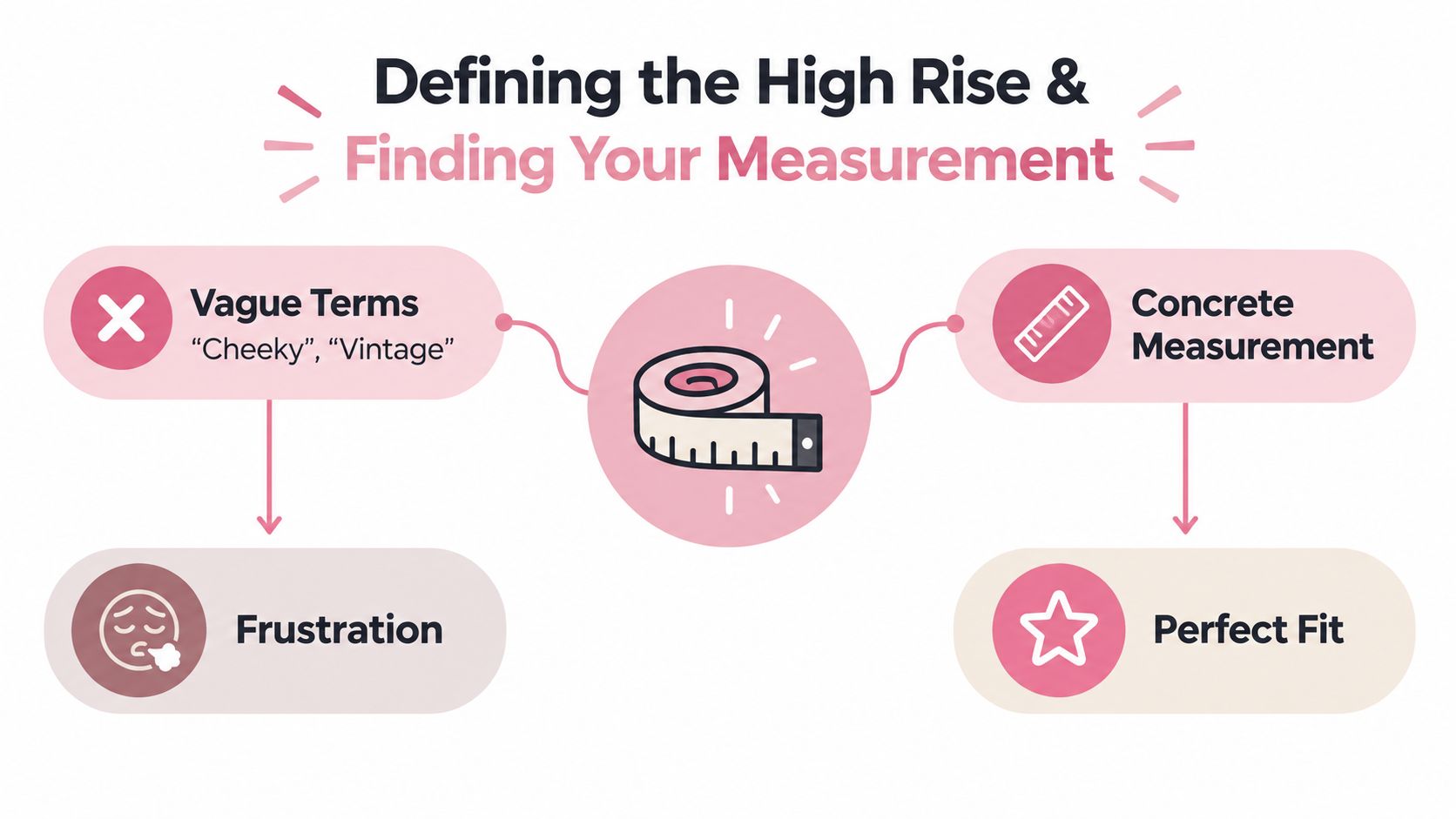
“High rise” can mean different things across brands, so don't rely on words such as “vintage,” “full coverage,” or “waist-smoothing” alone. Those descriptions suggest a silhouette, but they don't tell you where the waistband will sit on your torso or whether the leg openings will remain comfortable.
A high-rise panty generally reaches the natural waist area, often around the navel or slightly below it, rather than resting across the lower hip. The exact position depends on your torso length, the garment's front rise, the stretch of the fabric, and how tightly the waistband is tensioned. Two pairs with the same size label can therefore sit differently.
Start with your natural waist
Stand relaxed, without pulling your stomach in. Find the narrowest part of your torso, or identify the level where your body naturally creases when you bend gently to one side. That area is your natural waist. Your navel gives you another useful reference point, but it isn't located at exactly the same height on every body.
Measure around the torso at the level where you want the waistband to rest. Keep the tape parallel to the floor and snug, not tight. Then measure vertically from the crotch seam area to that preferred waistband position. This second measurement helps you understand the garment's rise requirement.
Use this simple process:
- Measure your body, not an old pair. A worn garment may have stretched, twisted, or changed shape after washing.
- Record both waist and hip measurements. The waistband needs to fit the waist area, while the body and leg openings must accommodate the fullest part of the hips.
- Check the product's rise description. If a listing provides garment measurements, compare them with your vertical measurement rather than guessing from the phrase “high rise.”
- Test the position while seated. A waistband that feels fine standing can become restrictive when your abdomen folds naturally as you sit.
Read fit signs accurately
A high-rise waistband should make contact without needing to be constantly repositioned. Rolling usually signals a mismatch, such as excess tension, insufficient height, a fabric that lacks recovery, or a waistband that's too narrow for the pressure it carries. Digging can indicate that the size is too small, but it can also come from concentrated elastic.
If the waistband slides downward, don't immediately assume you need a smaller size. A smaller pair may increase pressure without fixing the shape problem. Look at the garment's rise, stretch, and band width together.
For a more detailed measuring routine, use this underwear measurement guide. The aim is simple: translate vague style language into measurements you can compare, then validate those measurements in real movement.
High Rise Versus Mid Rise and Low Rise Cuts
Rise determines where the waistband meets your body, but it also changes how the panty interacts with your clothing and torso. A high rise extends toward the natural waist, a mid rise generally rests between the lower hip and waist, and a low rise sits closer to the hips. These are useful categories, not universal measurements.
Your torso length matters. On a short torso, a high-rise waistband may reach the navel quickly and feel tall, while a mid-rise cut may provide enough coverage without crowding the ribs. On a long torso, the same mid-rise pair may drift downward or leave the lower abdomen exposed.
Rise Comparison Matrix
| Rise Type | Waistband Placement | Best For | Ideal Clothing Pairing |
|---|---|---|---|
| High rise | Around the natural waist or near the navel | Full abdominal coverage, high-waisted bottoms, people who prefer a secure waistband | High-waisted trousers, high-rise denim, skirts, dresses with a defined waist |
| Mid rise | Between the hip and natural waist | Balanced coverage and a less elevated waistband | Mid-rise trousers, everyday denim, relaxed dresses |
| Low rise | Across the lower hip area | Low-slung bottoms and a lower waistband profile | Low-rise denim, low-waisted skirts, garments that sit on the hips |
High rise can feel stabilizing around the lower abdomen because more fabric contacts the torso. It also reduces the chance that the top of the panty will sit below a high-waisted trouser waistband. That alignment can prevent a gap where skin or underwear becomes exposed during bending.
Mid rise is often the adaptable middle ground. It may suit someone who dislikes fabric near the navel but still wants more coverage than a bikini cut. It can also work well when the outfit's waistband lands between the hip and natural waist.
Low rise has a clear purpose. Under low-slung jeans, a high-rise panty may bunch above the clothing line or become visible when you sit. A low-rise cut keeps the two waistbands closer together, although it offers less abdominal coverage.
Movement changes the decision. During a squat, the torso compresses and the abdomen changes shape. During sitting, the waistband may need to flex forward without cutting into the skin. A high-rise style can support that movement when its fabric and band distribute force well, but it can feel restrictive when the band is narrow or over-tensioned.
Choose the rise that matches both your body geometry and your outfit geometry. Coverage preferences matter, but the waistband should also sit where your clothes sit and remain comfortable in the positions your day requires.
Pros and Cons of High Rise Panties
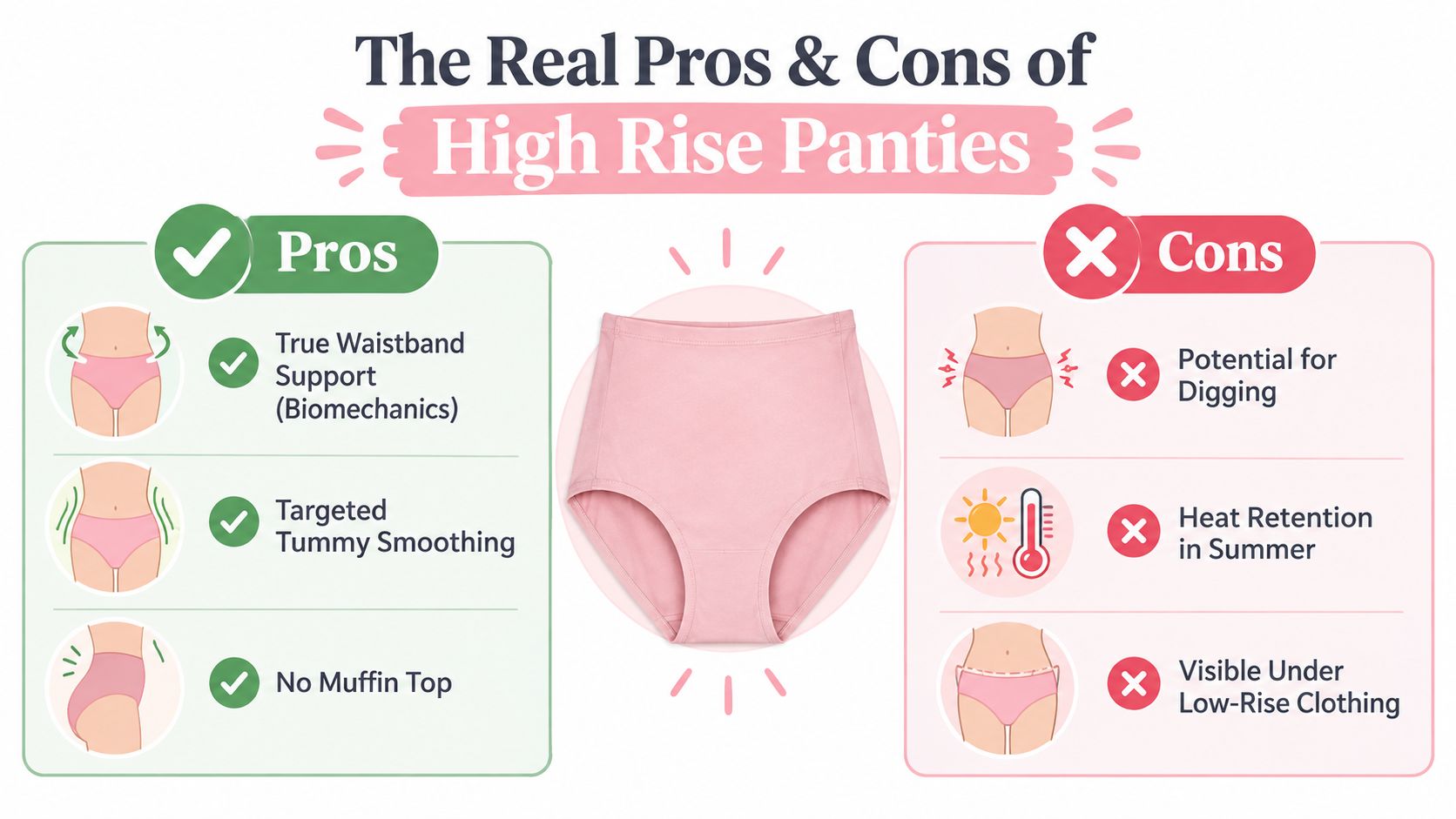
High rise offers more than extra fabric. It changes where the garment contacts the abdomen and how that contact is distributed. The result can feel secure, like a wider hand resting against the torso, or uncomfortable when a narrow elastic edge concentrates pressure along one sensitive line.
A controlled study of 10 nulliparous women examined high-waist and low-waist garments during squat movements. During isometric squats, high-waist garments produced peak intra-abdominal pressure of 17 ± 6 cmH2O, compared with 15 ± 6 cmH2O for low-waist garments, with p = 0.032. During dynamic squats, high-waist garments also reduced work of breathing to 16.2 ± 3.9 J·min−1, compared with 18.6 ± 5.7 J·min−1, with p = 0.026, as reported in this study discussion of high-waisted garments and pelvic-floor mechanics.
These findings do not mean every high-rise panty will feel supportive or produce the same response. They do show why waistband height and construction can change how pressure travels around the waist while you bend, squat, or sit.
Where high rise helps
A taller front panel provides more torso coverage, especially under trousers or skirts that sit at the natural waist. It can also reduce the sensation of the garment sliding down across the hips. For anyone who prefers a smoother transition between underwear and clothing, a well-fitted high rise can feel contained without needing frequent adjustment.
Construction determines how comfortable that coverage becomes. A wide, soft band spreads its force across more skin, much like a cushion distributing pressure instead of pressing at one point. A narrow elastic band places the same tension over a smaller area, which may create sharper marks and a stronger digging sensation.
Where high rise can disappoint
Pressure-comfort research on closely fitted garments found that discomfort rises once clothing pressure exceeds roughly 2.46 kPa for abdominal support bands. Pressure also changes with band geometry and distribution, not tightness alone, as described in this analysis of waistband width and riding. Because that threshold concerns support bands rather than every pair of panties, use it as a design reference, not a universal underwear limit.
Practical rule: A high waistband should feel broad and even, not like a thin cord pressing into one line of skin.
More coverage can also mean more warmth. Under low-rise clothing, the extra height may show. Firm or bulky leg edges can create visible lines even when the waistband remains hidden.
Test the garment through several movements. Walk, sit, bend, and lift one knee. If the band pinches, rolls, or leaves intense localized marks, the issue may be the construction or fit, not your body.
Outfit Pairings and Real World Use Cases
Picture a workday that moves from a desk to a meeting, then into a commute. High-rise panties often work well under high-waisted office trousers because the two waistlines follow a similar path. When you sit or reach forward, that alignment reduces the chance of a gap and limits waistband exposure.

Choose a smooth front, a waistband that lies flat, and leg openings without thick elastic ridges. With pale or lightweight trousers, a shade close to your skin may attract less attention than a bright contrast. As fabric gets closer to the body, raised seams and edges become easier to see.
When the outfit is forgiving
Denim and structured trousers usually hide texture better than thin, clingy fabrics. High-rise briefs can feel secure under high-waisted jeans when you want coverage across the abdomen and hips. Soft cotton or modal may suit a long day, as long as the leg openings stay flat instead of bunching beneath firm denim.
Loose dresses and wide-leg trousers allow more movement and concealment. Prioritize airflow, a comfortable gusset, and coverage that remains stable while you walk, sit, or bend. If the outer fabric does not cling, edge visibility becomes less important.
When high rise isn't the invisible choice
With silk, satin, slim trousers, and lightweight leggings, visible lines depend on fabric thickness, seam construction, and edge finish as much as rise height. A high-rise brief can cover the torso smoothly while its lower edges remain visible if they use raised stitching or firm elastic.
For a fitted dress, check the lower edge first. Raw-cut or minimal-seam finishes may sit flatter than traditional stitched elastic. High rise may also conflict with a low back, low waist, or deliberately dropped waistband.
A higher waistband improves coverage, not invisibility by itself.
For more guidance, read this guide to no-show underwear for office and casual wear. Test the complete outfit in daylight, both seated and standing. A mirror captures one posture, while clothing shifts as your hips flex and your waistband meets the chair.
Low-rise jeans generally pair more naturally with a lower panty cut because both waistlines sit together during movement. Under a short skirt, choose coverage according to how secure you want to feel while walking, sitting, and bending, rather than choosing by waistband height alone.
How to Choose the Right High Rise Construction
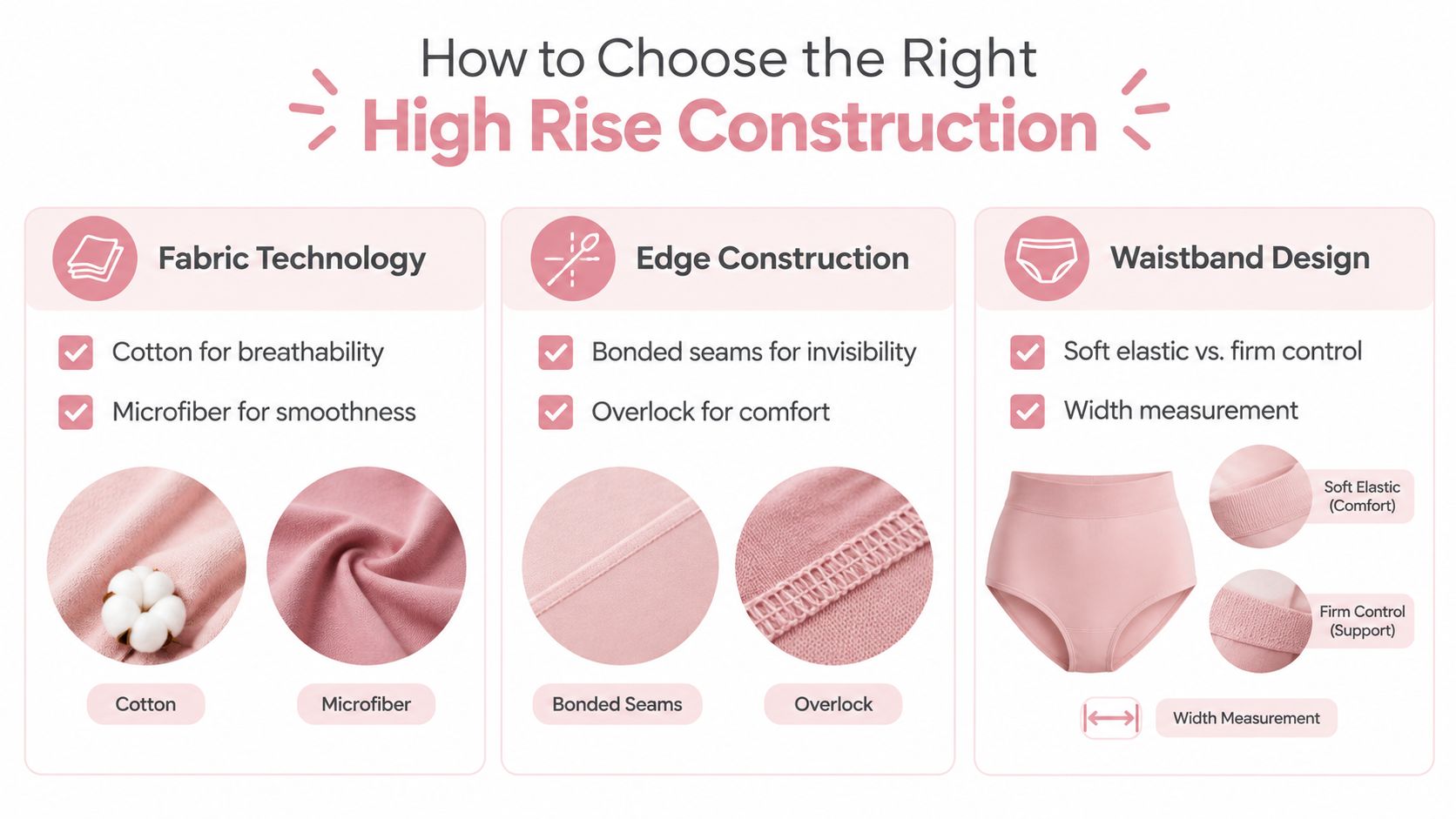
Product pages often emphasize rise, color, and silhouette. For comfort, you need to inspect the engineering details underneath those labels. Fabric, edge finish, and waistband design determine whether a high-rise panty stays smooth or becomes a source of pressure.
Begin with the fabric
Cotton can support breathability and familiar everyday comfort. Modal tends to feel soft and fluid against the skin, while microfiber can create a smooth surface under clothing. Mesh panels may help airflow in areas where a full, dense fabric feels warm.
Don't choose fabric by softness alone. A fabric also needs enough recovery to return to shape after stretching across the hips or abdomen. If it relaxes too much, the panty may slide. If it resists movement too strongly, the waistband may feel restrictive.
Inspect the edges
Raw-cut, laser-cut, or bonded edges can reduce raised outlines under fitted garments. Traditional overlock stitching may feel comfortable and flexible, but it can be more visible beneath clingy fabric. Neither finish is automatically right for every outfit.
Look at both the leg openings and the waistband. A smooth leg edge can prevent lines around the buttocks and thighs, while a carefully bonded waistband can help the top remain flat without a thick ridge.
Evaluate the band as a pressure system
A wide band often distributes force more gently than a narrow elastic strip. Check whether the product description explains the band's width, stretch, or bonding. If it only promises “sculpting” or “control,” you still need to consider how that pressure will feel after several hours.
A practical fitting test helps:
- Stand naturally. The top edge should touch the body without needing to be pulled upward.
- Sit for several minutes. Notice whether the front folds into the abdomen or the back rolls downward.
- Bend and squat. Look for riding, wedging, or tension at the leg openings.
- Wear the intended outfit. A pair can feel comfortable alone but create visible ridges under thin fabric.
Nuage Wears offers high-rise options within a broader comfort-focused range, including raw-cut styles, modal-based fabric, bonded bands, and breathable mesh constructions. Treat those details as construction points to compare with any other garment, rather than assuming the rise label tells you everything.
Building Your Ultimate Comfort First Drawer
A useful underwear drawer doesn't force one cut to handle every outfit. It gives you choices for different waistlines, fabrics, temperatures, and movement demands. High-rise panties can fill an important role, but they work best as part of a considered rotation.
Start with one pair that matches your natural-waist measurement and your preferred coverage. Then assess it in motion. Fit validation should include sitting, bending, walking, and wearing the outer clothes you own, because a standing mirror test can miss rolling, pressure, and visible edges.
Build around your daily problems
If your main issue is digging, look for a wider, softer waistband and even force distribution. If the problem is visible lines, examine raw-cut or bonded edges at both the legs and waist. If heat bothers you, consider breathable fabric or targeted mesh rather than choosing a lower rise.
For wedging, focus on the relationship between the leg opening, gusset width, hip coverage, and fabric recovery. A panty can have a high waistband and still ride upward if the lower pattern doesn't accommodate your shape during movement.
Match each pair to a task
Keep a high-rise brief for high-waisted trousers, jeans, and skirts when abdominal coverage matters. Add a smooth, minimal-edge style for fitted clothing. A breathable everyday option can serve long desk days, travel, and warm conditions, while a fuller-coverage cut may feel more secure under short skirts or relaxed dresses.
The European women's underwear market illustrates why briefs remain a foundational category. Women's underwear imports in Europe were estimated at €6.5 billion in 2019, up from €5.5 billion in 2014. Within that market, women's briefs and pants represented €2.2 billion, or 36% of import value, while bras represented nearly 63%, or €3.7 billion, according to the European women's underwear market overview. The figures describe market value, not personal fit, but they reinforce that briefs remain a substantial part of everyday apparel.
Use the same discipline when checking product images. For the blog display, the cover image should use a 280:210 aspect ratio, which is 4:3 because both dimensions divide evenly by 70, as explained by this aspect-ratio reference. Maintaining that proportion during resizing prevents distortion, and a fixed 280 × 210 implementation preserves the same width-to-height relationship, as shown by this aspect-ratio calculator.
Choose your high-rise underwear by behavior, not by height alone. The right pair should support your preferred coverage, stay aligned with your clothing, and let your body move without constant correction.
Nuage Wears offers comfort-focused high-rise, breathable, and stay-put underwear designed around concerns such as digging, visible lines, wedgies, and heat. Visit Nuage Wears to explore constructions that match your measurements, wardrobe, and everyday movement needs.


